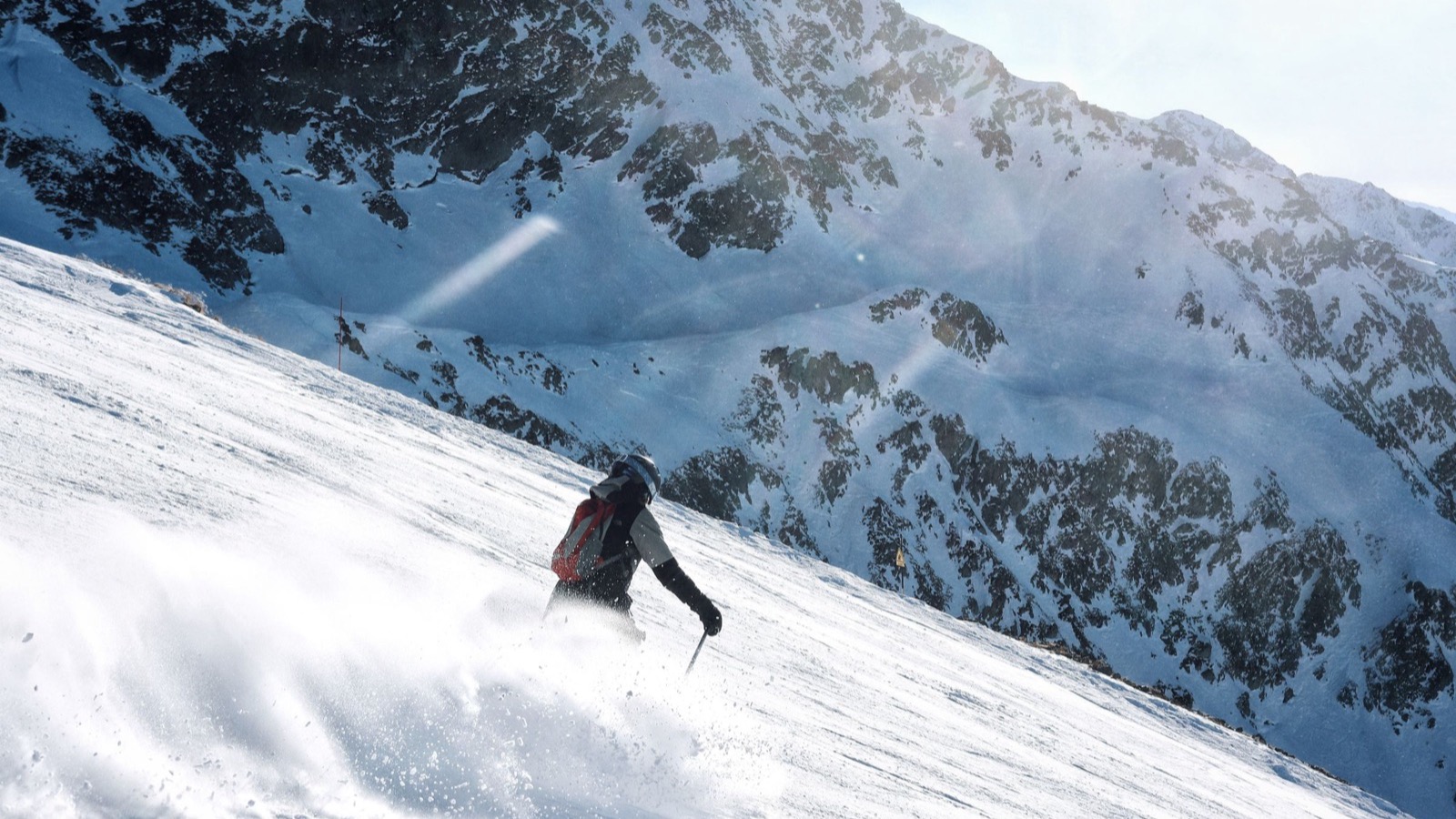
You stand still at the top of a lift, waiting for your friend, and your watch says 162. Two minutes later you ski a groomer at what feels like a moderate effort and it says 178. Then you sit down for lunch and it drops to 71 as if nothing happened.
Skiing produces some of the strangest heart rate data of any recreational activity, and most of it is real. The rest is measurement error. Sorting one from the other is worth doing, because a ski day is a genuine training load, and treating it like a casual outing is how people arrive home wrecked and unable to explain why.
TL;DR: Skiing is high-intensity intermittent work in the cold at altitude, and it drives heart rate higher than most people expect. In a telemetry study of 149 men skiing above 3,100 m, heart rate exceeded 80% of predicted maximum in two thirds of them. In a study of sedentary middle-aged men on a six-day trip, average heart rate while skiing was about 126 bpm, roughly 75% of predicted maximum, with almost a fifth of readings above 85%. Altitude raises heart rate at any given effort while lowering your true maximum, so sea-level zones do not transfer. Your wrist sensor also struggles under a jacket sleeve and in the cold. Treat the ski day as a hard training day, watch your next-morning HRV and resting heart rate, and expect it to take two to three days to normalise.
YouTube: Related video
Why skiing is harder than it feels
Skiing does not feel like running, because it is not continuous. That is precisely what makes it metabolically awkward.
A run lasts two to four minutes. Within it you have moments of near-maximal loading: a steep pitch, a mogul field, a traverse where you skate, a fall where you fight to get up. Between those you have lift rides of five to ten minutes where your heart rate drops. Repeat that twelve times and you have done a genuinely hard interval session that felt like a day out.
Add the other loads:
- Isometric work. You hold a semi-squat for minutes at a time. That raises heart rate and blood pressure without much movement, which is why your legs burn and your watch climbs even when you feel like you are standing still.
- Cold. Cold exposure raises heart rate and blood pressure at a given workload, and it constricts the blood vessels in your hands and feet first.
- Altitude. Most resorts sit between 1,500 and 2,500 m, with lifts going higher. At altitude, the same effort costs a higher heart rate, and your true maximum is lower.
- Adrenaline. Fear and excitement both push heart rate up before you have made a single turn.
- Gear. Boots, skis, layers and a helmet add several kilos that you carry, lift and hike in.
- Dehydration and alcohol. Both are common on ski days, and both raise heart rate for hours.
What the research actually shows
The 3,100 m telemetry study
Grover and colleagues recorded continuous electrocardiograms on 149 men during recreational skiing above 3,100 m. The finding that surprises most people: heart rate exceeded 80% of predicted maximum in two thirds of the subjects.
These were ordinary recreational skiers, not racers. Two thirds of them spent part of the day in what most training frameworks call zone 4.
The same study found ST-segment changes in five men, all over 40, but concluded that for physically fit older men, mountain skiing did not appear to place more coronary stress than comparable exercise at low altitude in men of average fitness. In other words, the load is high, but fit people tolerate it.
The six-day trip study
Kahn and colleagues tracked ten habitually sedentary men around 51 years old through a six-day ski trip between 1,000 and 2,485 m. The data is a useful reality check for anyone who thinks a ski holiday is a rest:
- Mean heart rate while skiing was about 126 bpm, roughly 75% of predicted maximum.
- On the first day, 17.9% of recorded values were above 85% of predicted maximum, representing almost a fifth of actual skiing time.
- Resting heart rate was significantly elevated compared with before the trip, and stayed that way for most of the week.
That last point is the one to remember. A ski holiday is not a break from training. It is a training camp with worse sleep and more wine.
The risk data
Burtscher's case-control study of sudden cardiac deaths during mountain activities found that risk was greatest on the first day at altitude. Altitude itself and the duration of activity did not modify risk much, but the longer the gap since the last food and fluid intake, the higher the risk. Skiers who died were far more likely to have had a previous heart attack, known coronary disease, or high blood pressure, and were less likely to exercise regularly.
On the other side of the ledger, a cohort of 52,755 long-distance cross-country skiers found that more races and faster finishing times were associated with a higher risk of arrhythmias, mainly atrial fibrillation. That study is about extreme endurance racing, not recreational downhill skiing, and it should not be used to scare anyone off a groomer. It is a reminder that the dose matters at the top end.
Why your watch gets it wrong
Some of the strange readings are physiology. Some are the sensor having a bad day.
The sensor is under a sleeve. Optical heart rate needs skin contact and light penetration. A jacket cuff or glove gaiter pushing the watch up, or snow getting under the strap, breaks the signal.
Cold hands mean poor perfusion. The optical sensor works by detecting blood volume changes. When your hands are cold, peripheral blood flow drops and the signal-to-noise ratio falls apart. This is why your heart rate reads 90 when you know it is 150, or drops out entirely.
Motion artifact. Skiing involves sharp impacts, pole plants and vibration. Optical sensors handle this worse than chest straps do.
Cadence lock. When the optical signal is weak, the algorithm can lock onto your movement frequency instead of your pulse. If your heart rate sits suspiciously steady at 165 to 175 while you turn, that may be your turn rate, not your heart. Our guide to Apple Watch cadence lock covers how to spot it and what to do.
Auto-pause and workout type. If the watch pauses on lift rides, your average will be skewed. If it does not recognise skiing as a workout at all, you get fragments.
Altitude and cold both shift the numbers legitimately. At altitude your submaximal heart rate is higher and your maximal heart rate is lower. So the same corner that cost you 150 bpm at sea level might cost 165 on the mountain, and your calculated zones are now wrong in both directions.
Your zones do not transfer to the mountain
This is the part most people miss. Zones are usually calculated from a max heart rate you tested at home, at low altitude, in normal temperatures.
On the mountain:
- Your max is lower. Max heart rate falls with altitude, typically by a few beats per minute per thousand metres once you are above roughly 1,500 m. It also falls in the cold.
- Your submax is higher. Every submaximal workload costs more beats, because there is less oxygen per breath and your heart has to work harder to deliver it.
- Your zone percentages are therefore off. Zone 2 at sea level might be 125 to 140 bpm. On the mountain, that same effort could put you at 145 to 155, which your watch will label zone 3.
The practical consequence: do not try to train in zone 2 on a ski holiday by watching your wrist. If you want an easy day, ski easy terrain, take more breaks, and use your breathing as the guide. The cold weather running guide covers the same mismatch for runners, and the altitude piece in our altitude, HRV and sleep guide explains what happens to your overnight data when you travel to elevation.
How to use the data sensibly
You do not need perfect heart rate data to manage a ski trip well. You need to treat the day as load and watch the recovery.
1. Log the day as hard training. A full ski day with twelve runs is closer to a long interval session plus a strength session than to a walk. Do not stack a hard gym session on top.
2. Check the next morning. Look at resting heart rate and HRV before you get out of bed. A resting heart rate 5 to 10 bpm above your baseline, with HRV clearly down, means the day registered.
3. Expect two to three days. Cold, altitude, dehydration, poor sleep in a hotel and alcohol all delay recovery. The Kahn study found elevated resting heart rate across a whole six-day trip, which is exactly what you would expect from accumulated load.
4. Watch the trend, not the day. If your resting heart rate is still elevated on day four, you are accumulating debt. Take a half day.
5. Use the lift rides. They are free recovery intervals. Sit down, drink water, and let your heart rate come down rather than standing in the cold with your skis on.
6. Do not chase a heart rate target on the slope. Watch the terrain and your breathing. If you cannot speak in full sentences on a run you are working hard, and that is fine as long as you did not plan an easy day.
Getting better data on the mountain
If you actually care about the numbers, four changes make a big difference:
- Wear the watch snug, above the wrist bone, with the sensor flat against skin. Not over a baselayer if you can avoid it, and definitely not loose.
- Warm your hands before you check. A cold wrist reads low. Put your glove back on and look later.
- Use a chest strap if you want accuracy. Optical sensors are convenient; chest straps are reliable in cold, motion-heavy conditions. This is the one situation where the strap is worth the hassle.
- Set the workout correctly. Newer watchOS versions include downhill skiing and snowboarding workout types. If yours does not offer them, use a generic outdoor workout rather than leaving it off entirely, so the day at least appears in your activity history.
The safety conversation worth having
Skiing is a genuinely demanding cardiovascular activity, and the data above is a reason to respect it rather than fear it.
- The first day is the riskiest. That is what the case-control data shows. Take it easier than you want to, especially at altitude and especially if you travelled straight from sea level.
- Eat and drink before you get on the lift. Longer gaps without food and fluid were associated with higher risk in the same study. A late breakfast and no water until 2 p.m. is a bad pattern.
- Skip the alcohol at lunch. It raises heart rate, worsens hydration and coordination, and contributes to the Holiday Heart pattern of arrhythmias after drinking. Our holiday heart guide covers that mechanism.
- Know the red flags. Chest pain or pressure, unusual breathlessness at low effort, palpitations that do not settle, dizziness or fainting, or a resting heart rate that stays high for days all warrant medical attention. At altitude, shortness of breath that worsens at rest can be a sign of high-altitude illness, which means descending, not pushing on.
- If you have cardiac risk factors, get checked first. Previous heart attack, known coronary disease, uncontrolled hypertension, diabetes or a strong family history are all worth a conversation with your doctor before a ski trip. The risk data is unambiguous about who is over-represented in these events.
The bottom line
Skiing heart rate data is not broken. It is a genuinely demanding activity in conditions that make measurement harder, at an altitude that shifts your physiology in both directions.
Use the data for what it is good at: confirming that the day was a real training load, and telling you how long to take to recover. Do not use it to chase zones that were calculated at sea level. And treat the first day of a trip the way the research says to treat it, which is with more restraint than the excitement suggests.
Century AI helps you understand your body with a daily health score, recovery score, and sleep insights, using the watch you already wear.