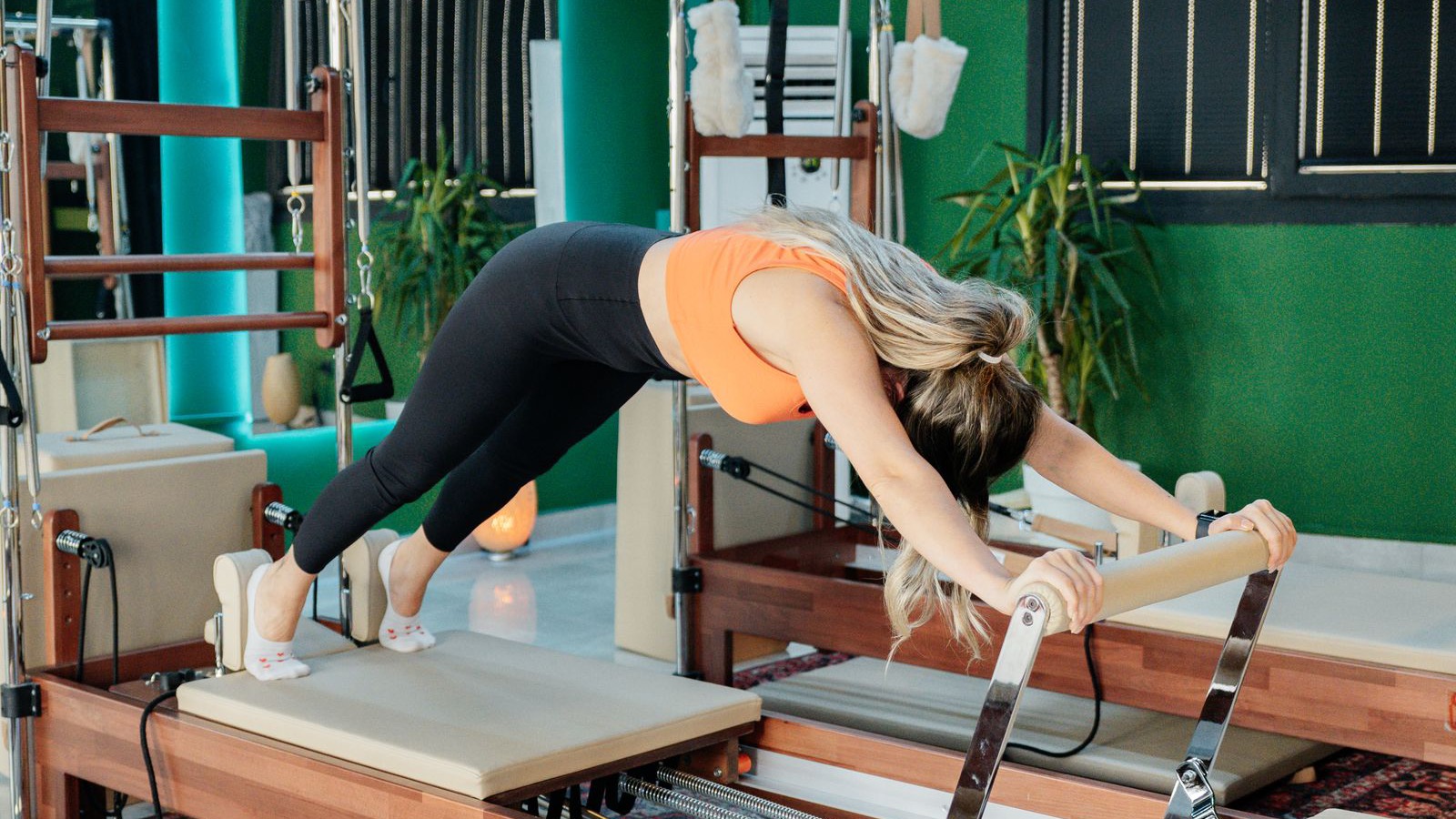
You finish a 50-minute reformer class. Your core is shaking, your shoulders are done, and you genuinely worked. Then you look at your watch: 6 exercise minutes, 180 active calories, Zone 1 for most of it.
It feels like the watch is telling you that you did nothing. It isn't. It's telling you that you didn't do cardio, which is a different claim, and one that's mostly correct.
TL;DR: Pilates is a low-to-moderate intensity strength and control discipline, not an aerobic one. In an ACE study, a beginner mat routine averaged 54% of maximal heart rate, below the ACSM aerobic training range of 64-94%, and an advanced routine reached 62% with 43% of VO2 max — roughly the energy cost of walking 3.5 to 4 mph. A 2020 study of 21 mat exercises found half reached moderate heart-rate intensity, with the whole session burning around 214 calories. Your watch under-counts Pilates because its exercise-minutes rule wants sustained brisk activity, and because optical heart rate struggles during floor work. But Pilates does show up in blood pressure, heart rate variability, flexibility, and balance — just not in the rings.
YouTube: Related video
What Pilates actually asks of your heart
Pilates is built around controlled movement, breath coordination, and sustained muscular tension. That's a very different cardiovascular demand from walking, cycling, or running, where large muscle groups contract rhythmically and continuously for tens of minutes.
In Pilates, you work hard in short bursts — a hundred, a teaser, a long hold — separated by position changes, setup, and cueing. Heart rate rises during the effort and falls during the transition. The average across a class ends up modest even when the peaks feel brutal.
The best-known measurement of this comes from the American Council on Exercise, which put participants through beginner and advanced mat routines while measuring heart rate and oxygen consumption.
The beginner routine averaged 54% of maximal heart rate. That is below the ACSM recommended range for improving cardiorespiratory fitness, which starts around 64% of maximum. The advanced routine did better, averaging 62% of maximal heart rate and 43% of VO2 max — roughly the energy cost of walking 3.5 to 4 mph.
The study's own conclusion was blunt: the cardiovascular benefits of Pilates appear to be limited, and participants feel like they're working harder than they are aerobically. That's not a knock on Pilates. It's a description of what it is.
The exercise-by-exercise picture
A 2020 study in the Journal of Bodywork and Movement Therapies looked at 21 of the 34 original mat exercises individually, monitoring heart rate and rating of perceived exertion after each one.
Two findings are worth keeping.
First, perceived effort tracked heart rate closely — the correlation was strong at about 0.82. So your sense of "that was hard" is a decent guide to relative intensity within a class, even if the absolute numbers stay low.
Second, roughly half the exercises reached moderate heart-rate intensity, and the estimated energy cost of the whole session was about 214 calories with an estimated VO2 max around 34.7 ml/kg/min. The authors noted that at five sessions a week, the weekly energy expenditure would start to matter for public health guidelines. One class a week, not so much.
| Session type | Typical intensity | Fills the Exercise ring? | Builds VO2 max? |
|---|---|---|---|
| Beginner mat Pilates | ~54% HRmax | Usually barely | No |
| Advanced mat Pilates | ~62% HRmax | Partially | Minimally |
| Reformer with flow and tempo | Varies, often 60-70% | Sometimes | Slightly |
| Cardio Pilates / Pilates fusion | 70-80% HRmax | Yes | Somewhat |
| Pilates + brisk walk | Combined | Yes | Yes, from the walk |
That last row is the practical answer for most people, and we'll come back to it.
Why your watch gives you four exercise minutes
The Exercise ring isn't measuring "did this feel hard." It's built on a threshold rule: activity at or above a brisk-walk equivalent, sustained for at least a minute, with heart rate and motion supporting the call.
Pilates trips this in three places.
Intensity sits below the threshold for long stretches. If the class average is 54-62% of your maximum, much of it lives under what the watch treats as brisk.
The effort is intermittent. A ring-filling session needs sustained elevation. Pilates alternates work and setup, so even a hard class produces a choppy heart-rate trace.
The optical sensor loses signal during floor work. Wrist heart rate depends on blood flow near the skin. When your wrists are flexed, bearing weight, or pressed against a mat, the sensor sees less and reports less. Long stretches of mat work often produce lag, dropouts, or readings 10 beats below reality.
None of that is a malfunction. It's a metric designed for one kind of activity being applied to another.
If you want a fairer record, start a workout manually — Pilates or Other — rather than relying on auto-detection. That preserves the session in your history even when the ring stays mostly empty, and it gives you a duration and calorie estimate you can compare week to week.
What Pilates does move, according to the data
Here's where the story gets more interesting, because Pilates has a respectable evidence base in exactly the places wearables measure poorly.
A 2026 randomized trial in the Journal of Hypertension took 28 women with treated hypertension, aged 39 to 59, and gave half of them supervised Pilates twice a week for 13 weeks. The Pilates group saw significantly greater reductions across ambulatory blood pressure measures, including a 10.3 mmHg drop in 24-hour systolic pressure. They also improved on a deep-breathing autonomic reflex test, a marker of parasympathetic function.
That's a meaningful blood pressure effect from a low-to-moderate intensity intervention — the kind of change you'd normally associate with considerably more punishing training.
A second 2026 trial compared eight weeks of Pilates with eight weeks of yoga in adults with moderate stress, both twice weekly for 60 minutes at a moderate perceived effort. Neither changed body composition. Both improved flexibility, balance, autonomic nervous system function, and mental health, with similar results between the two.
Put those together and you get a coherent picture. Pilates is a poor cardio stimulus and a decent autonomic, mobility, and strength-endurance stimulus. It raises your capacity to tolerate stress and to control movement, which is not the same thing as raising your aerobic ceiling.
The strength side is real, but invisible to your rings
The other thing Pilates does — building trunk endurance, hip control, and postural stamina — has no home in the Activity rings at all.
Apple Watch measures movement, not tension. A 40-second side plank and a 40-second scroll on the sofa produce similarly unimpressive ring results and completely different physiological adaptations. If your only feedback loop is the rings, Pilates will always look like it did nothing.
That's a measurement gap, not an outcome gap. Which means you need different feedback.
Reformer versus mat: does it change the intensity story?
Slightly, and not as much as the marketing suggests.
Reformer classes tend to run at a higher tempo and add spring resistance, so the work feels heavier and heart rate averages a bit higher than a slow mat class. But the underlying structure is the same: brief efforts, positional resets, and cueing. Unless the class is explicitly programmed as cardio Pilates, or you're moving between apparatus with minimal rest, you're still looking at roughly 60-70% of maximum for short stretches and much lower between them.
Where reformer does have an edge is load. Springs give you progressive resistance in a way mat work can't easily replicate, which matters for the strength-endurance side and for people whose joints don't tolerate bodyweight loading patterns. It doesn't turn the class into Zone 2.
Mat Pilates has the opposite advantage: it's portable, it's cheap, and a well-sequenced mat class demands more trunk control because you're managing your own bodyweight without assistance. If you're choosing one, choose the one you'll actually do twice a week.
How to track Pilates progress when the rings don't help
Pick two or three of these and check them monthly. They're crude, but they're honest, and they capture the things Pilates actually changes.
Resting heart rate trend. A 13-week Pilates intervention improved autonomic function. If your RHR drifts down a beat or two over a couple of months while sleep stays constant, that's a signal. More on reading it in what your resting heart rate reveals.
HRV baseline, not daily values. Look at the 30-day average. Vagal tone improvements show up slowly and get buried in daily noise.
Heart rate recovery after a standard effort. Time how long it takes to drop 20 beats after a fixed hill or a hard set. Faster recovery over months is a real adaptation.
A hold test. Front plank to failure, side plank each side, or a single-leg stand with eyes closed. Write down the number. Retest in four weeks.
Sit-to-stand quality. Ten reps from a chair without hands, watching for knee valgus or trunk collapse. Video it. Compared side by side, three months of Pilates shows up clearly.
Blood pressure, if you have a cuff. Given the trial above, this is the metric with the best evidence for Pilates specifically. Measure at the same time of day, average a week.
How to fit Pilates into a week that also has Zone 2
You don't have to choose, and you shouldn't. The mistake is expecting one modality to do both jobs.
A workable structure for a general-health week:
- Two Zone 2 sessions, 40-60 minutes each, at a conversational pace. This is your aerobic base and the thing that moves VO2 max. Here's a complete Zone 2 training guide if you're starting from scratch.
- Two Pilates sessions, mat or reformer, 45-60 minutes. This is your control, mobility, and trunk endurance work.
- One strength session with external load, if you can. Pilates is not a substitute for progressive resistance training when it comes to bone density and muscle mass after 40.
- Walking, daily, as the glue.
If you only have three slots, do two Zone 2 sessions and one Pilates class, and walk on the other days.
The intensity distribution also matters here. If Pilates is your only structured exercise, you're effectively doing an 80/20 plan with the 20% missing — all low intensity, nothing pushing the ceiling. That's comfortable and it's not enough on its own. The reverse is worse: all intervals, no control work, and an injury by March.
The one adjustment worth making
If you want Pilates to count for more without turning it into something it isn't, add a walk.
Ten minutes of brisk walking before class, or a 15-minute walk after, changes the session's cardiovascular profile completely. You get the aerobic stimulus from the walk and the control work from the class, and your watch records both honestly.
That's not gaming the metric. It's making the training match the goal.
At Century AI, a Pilates day shows up in your daily health score through the recovery side — resting heart rate, HRV, sleep quality — rather than through calories or zone minutes, because that's where the signal actually is. A hard reformer class that leaves your rings untouched can still show up as a slightly suppressed HRV the next morning, which is a far better description of what happened than 6 exercise minutes.
The bottom line
Pilates averages 54-62% of maximal heart rate, which is below the aerobic training range and roughly equivalent to a brisk walk. That's why it barely registers as exercise minutes and zone time.
But the same low-to-moderate intensity produces measurable improvements in blood pressure, autonomic function, flexibility, and balance — outcomes your rings were never designed to show.
So let Pilates be Pilates. Track it with a manual workout, judge it with a plank hold and a blood pressure cuff, and get your aerobic work from actual aerobic sessions. The watch will still under-count the class, and now you'll know why that's not a problem.
Century AI helps you understand your body with a daily health score, recovery score, and sleep insights — using the watch you already wear.