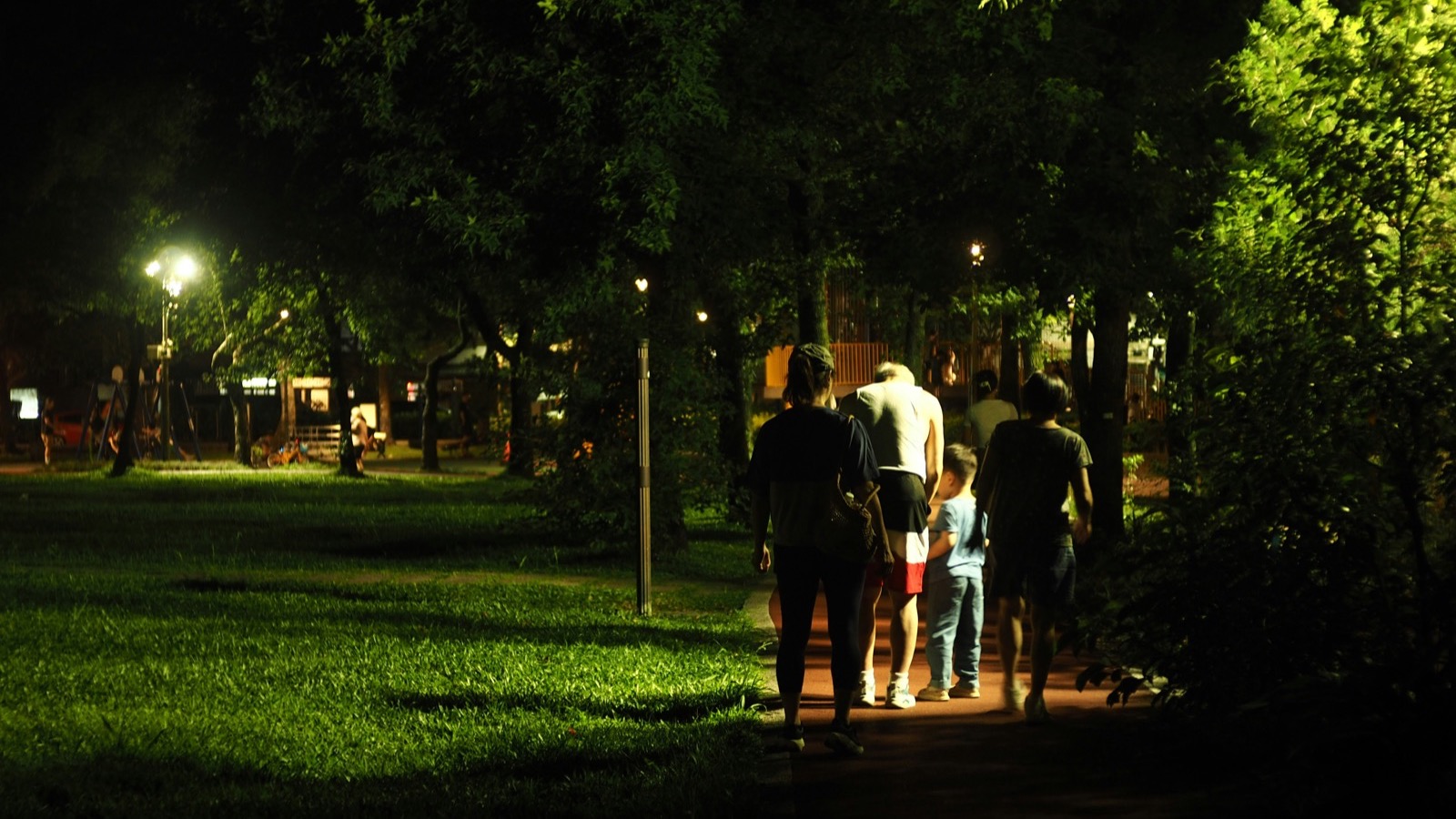
Most advice about walking is about volume: 10,000 steps, 150 minutes a week, walk more. All true. All easy to ignore on a Tuesday night when you're full and the sofa is right there.
But there's a narrower version of the walking advice that holds up better than almost anything else in the "small habits" genre: walk after you eat. Not for fitness. Not for steps. For what happens to your blood sugar in the 90 minutes after a meal.
That window is worth understanding, because it's where the evidence is strongest and the effort is lowest. A 10-minute walk is not a workout. It's barely a walk. And it changes the shape of your post-meal glucose curve in a way you can measure.
TL;DR: Light walking after a meal blunts the post-meal glucose spike, and walking beats standing, which beats sitting. A meta-analysis of 7 crossover trials found light-intensity walking breaks reduced postprandial glucose (∆ = −0.72) and insulin (∆ = −0.83) versus uninterrupted sitting, with a moderate effect size. In adults with type 2 diabetes, 10 minutes of walking after each main meal lowered overall post-meal glucose more than a single 30-minute walk — with the evening meal improving the most (22% lower). Timing matters as much as duration: in a 2025 crossover trial, a 10-minute walk started immediately after a glucose drink matched a 30-minute walk started 30 minutes later on 2-hour glucose, and beat it on peak glucose. The catch is that in healthy young adults the benefit is acute and post-meal only — 24-hour glucose control didn't change. So this is a real lever on glucose handling, not a substitute for total activity, diet, or medication.
YouTube: Related video
Why the timing matters more than the total
When you eat, glucose enters your bloodstream and your pancreas releases insulin to move it into cells. How high that glucose goes, and how long it stays up, depends on the meal, your insulin sensitivity, and — this is the part people miss — what your muscles are doing at the time.
Working muscle takes up glucose through a pathway that doesn't depend on insulin. Contractions move a glucose transporter called GLUT4 to the muscle cell surface, so the muscle pulls glucose out of the blood directly. There's a second mechanism too: muscle glycogen resynthesis. After contraction, muscle is hungry for glucose to refill its glycogen stores, which further clears the bloodstream.
The practical consequence is that a walk during the post-meal window does something a walk four hours later doesn't. It competes with the glucose entering your blood in real time.
This is also why the "calories burned" framing misses the point. Ten minutes of easy walking burns somewhere in the range of 30 to 50 calories. Nobody's glucose control is transformed by 40 calories. What changes is the handling — the peak, the area under the curve, and the insulin needed to get there.
And the peak matters. Postprandial glucose excursions are an independent contributor to cardiovascular risk and to overall glycaemic control, which is why researchers keep studying something as unglamorous as a post-dinner stroll.
What the research actually shows
Four studies tell most of the story.
Walking beats standing, and standing beats sitting
The cleanest summary is a 2022 systematic review and meta-analysis in Sports Medicine, which pooled seven randomised crossover trials — short, tightly controlled studies where the same people did each condition on different days. The glucose meta-analysis included 461 participants, mostly adults with overweight or obesity.
| Break from sitting | Postprandial glucose | Postprandial insulin | Systolic blood pressure |
|---|---|---|---|
| Standing | Small reduction (∆ = −0.31) | No significant effect | No effect |
| Light-intensity walking | Moderate reduction (∆ = −0.72) | Moderate reduction (∆ = −0.83) | No effect |
| Walking vs standing | Small additional reduction (∆ = −0.30) | Additional reduction (∆ = −0.54) | No effect |
Two things stand out.
First, standing genuinely helped glucose — small, but statistically significant. That's a useful floor if you're on a call, on a train, or at a desk you can't leave. It's not a substitute for walking, though. When the researchers compared walking against standing head to head, walking still won.
Second, neither standing nor walking changed blood pressure in these acute studies. The authors were explicit about that. The glucose and insulin effects are the signal; the blood pressure story would need longer trials.
One more detail worth knowing: effects were more pronounced in participants with overweight than in participants with obesity, which the authors suggested reflects a greater metabolic compromise in the obesity group. In other words, the people who need the most help get the least from a single 10-minute walk. That's an argument for stacking the habit rather than treating it as a cure.
Ten minutes after each meal beat thirty minutes once a day
The most practical trial here was published in Diabetologia in 2016. Forty-one adults with type 2 diabetes were randomised to two weeks of one of two pieces of advice, then crossed over to the other:
- Walk 30 minutes a day, whenever you like
- Walk 10 minutes after each of the three main meals, starting within 5 minutes of finishing eating
Both meet activity guidelines. Both involve the same 30 minutes of walking. And glycaemia was measured continuously for 7 days in each phase, so the researchers weren't relying on recall.
Post-meal walking won. The incremental area under the glucose curve over the 3 hours after a meal was meaningfully lower on the post-meal schedule: a ratio of geometric means of 0.88 (95% CI 0.78–0.99). The breakdown by meal is the interesting part:
| Meal | Post-meal glucose with split walks vs one daily walk |
|---|---|
| Breakfast | 0.87 (95% CI 0.72–1.05) |
| Lunch | 0.94 (95% CI 0.80–1.10) |
| Dinner | 0.78 (95% CI 0.67–0.91) |
The overall improvement was almost entirely driven by dinner. The authors' explanation: the evening meal is usually where the most carbohydrate is, and it's also when people are most sedentary. A 10-minute walk after dinner interrupts both at once.
That's the single most actionable finding in this whole body of research. If you only ever do one post-meal walk, do it after dinner.
Starting right after the meal matters
A 2025 crossover trial in Scientific Reports tested something subtly different: does the 30-minute delay matter?
Twelve healthy young adults completed three conditions after drinking 75 g of glucose: rest, a 10-minute walk started immediately, and a 30-minute walk started 30 minutes later.
- Both walking conditions lowered 2-hour glucose AUC and mean glucose compared with resting.
- There was no significant difference between the 10-minute immediate walk and the 30-minute delayed walk on AUC or mean glucose.
- The 10-minute walk started immediately produced a significantly lower peak glucose than resting (164.3 vs 181.9 mg/dL). The 30-minute delayed walk did not significantly reduce the peak.
Read that again, because it's counterintuitive. Ten minutes of walking, started right away, matched thirty minutes of walking started half an hour later on total glucose exposure — and did better on the thing that most people care about, the peak.
The authors' interpretation was simple: glucose peaks roughly 30 to 60 minutes after eating. If you start walking 30 minutes in, you've already spent the top of the curve sitting down. If you start immediately, your muscles are working while the glucose is arriving.
The lesson is not "longer walks are useless." It's that waiting is the part that costs you. If you're choosing between "walk now, but only for 10 minutes" and "walk for 30 minutes, starting later," walk now.
What happens in healthy people (the honest caveat)
The trial above used a glucose drink, which is a deliberately clean test. Real life is messier.
A 2024 free-living study asked physically inactive but metabolically healthy young women to complete three 15-minute brisk walks, 30 minutes after breakfast, lunch, and dinner, on one day, and to go about normal life on another. Continuous glucose monitors ran throughout.
Post-meal walking reduced 3-hour post-meal glucose, with the biggest effect after dinner (3-hour average glucose 6.71 vs 7.55 mmol/L). But it did not improve 24-hour glucose control.
One detail from that study is worth pausing on: participants accumulated around 9,159 steps on the control day, without trying. These weren't sedentary people. They were already moving plenty — and the timing of the movement still changed the post-meal curves. That's the whole argument for walking after meals rather than walking more in general.
The other half of the finding is a limitation. If you're metabolically healthy, don't expect post-meal walks to move your 24-hour average glucose. The benefit is local and acute. Which is fine — you're not doing this for a number on a lab report. You're doing it because repeated glucose excursions, day after day, are the thing you're trying to avoid.
What it does not do
Post-meal walking gets oversold in one direction and undersold in another. Here's the honest ledger.
It doesn't replace total activity. The public health guidance is 150 to 300 minutes of moderate-intensity activity a week, plus strength training twice a week. Ten-minute walks after meals can contribute to that total, but they don't buy you out of it. Our guide to Zone 2 training covers what higher-volume low-intensity work does that a post-meal stroll doesn't.
It doesn't fix the meal. Walking after a 1,500-calorie dinner doesn't neutralise the dinner. The Diabetologia trial's own conclusion was that post-meal activity is a useful addition to dietary management, not a replacement for it. If you're also curious what continuous glucose data actually shows you about recovery and sleep, we wrote about what a CGM can teach you.
It doesn't change your medication needs. If you take insulin or a sulfonylurea, adding exercise to the post-meal window can change your glucose response in ways worth discussing with your clinician — including a hypoglycaemia risk that doesn't apply to people not on those drugs. Don't restructure your medication timing around a blog post.
The effects are acute, and that's the point. You don't get a permanent upgrade from one walk. You get a smaller excursion after that meal. The return comes from repetition.
How to actually do it
The specifics are forgiving.
When: within 5 to 30 minutes of finishing the meal. Starting sooner looks better, based on the peak glucose data, but the difference between minute 5 and minute 25 is small compared with the difference between walking and not.
How long: 10 minutes is enough to see the effect in the trials. 15 is comfortable. 30 is fine if you have it, and you can split it — 15 minutes after lunch and 15 after dinner is a clean way to hit the same total.
How fast: conversational. You should be able to talk in full sentences without gasping. This isn't a training stimulus; it's a metabolic one, and going harder doesn't buy you more glucose clearance. If anything, easy and repeatable beats fast and rare.
Which meal: dinner, if you're picking one. It's usually the largest carbohydrate load and the most sedentary stretch of the day.
What counts: continuous walking is the thing that was studied, so march in place, use a walking pad, walk laps of the block in the rain, or take the stairs up and down. Breaking it into two 5-minute chunks probably keeps most of the benefit, though that hasn't been tested as carefully.
How to remember it: attach it to something that already happens. Clearing the table, loading the dishwasher, hanging up the call. A habit that requires a decision every night doesn't survive a long day.
A simple week, if you want a template:
| Day | Post-breakfast | Post-lunch | Post-dinner |
|---|---|---|---|
| Work days | Optional, 5–10 min if easy | 10 min walk, wherever you are | 15 min walk, no exceptions |
| Days off | Optional | 15 min | 20–30 min, ideally outside |
The pattern matters more than the perfection. Three evening walks a week beats one heroic weekend hike, because you're repeating the exposure to the post-meal window.
What your watch can and can't tell you
Your wearable doesn't measure glucose, and it won't. The relevant Apple Watch sensors — heart rate, HRV, movement — are downstream of a different system.
What it can do is help you check the habit is actually happening, and keep an eye on the things that tend to move alongside it:
- Step timing, not step totals. The interesting signal is whether your step count clusters after meals or in one daily block. Flip to the hourly view in Apple Health or your fitness app and look for a bump after dinner.
- Resting heart rate and HRV trends. Better post-meal activity often shows up as better glucose handling, which over weeks can nudge recovery markers. But this is a slow, noisy signal at the level of a single person. Daily changes will swamp it.
- Sleep. An easy walk after dinner is unlikely to hurt sleep, and for a lot of people the alternative to the walk is lying on the sofa and scrolling, which does. If you want the data on evening habits, our piece on does working out at night ruin your sleep covers what the trials say.
- Weekly averages, not daily readings. If you're testing whether a habit is working, compare weeks. We wrote about the specific trap of trusting daily scores over trends.
This is the reason we built Century around trends rather than single days. A daily health score that swings on noise is useless for habit decisions. A four-week view of recovery, resting heart rate, and sleep is something you can actually act on — which is what you need when you're trying to find out whether a 10-minute habit after dinner is worth keeping.
Bottom line
Walking after meals is one of the few small interventions where the mechanism is understood, the trials are practical rather than theoretical, and the required dose is genuinely small.
What the evidence supports:
- Light walking beats standing, and standing beats sitting. If you can only stand, stand. If you can walk, walk.
- Dinner is the highest-value meal. The biggest measured improvement came after the evening meal in type 2 diabetes.
- Sooner beats later. A 10-minute walk started immediately matched a 30-minute walk started 30 minutes later on total glucose exposure, and beat it on peak.
- Ten to fifteen minutes is the realistic target. Not a workout. A habit.
- The benefit is acute. You're managing this meal's excursion, repeatedly. That repetition is the intervention.
If you have type 2 diabetes, prediabetes, or any interest in your metabolic health, this is about the cheapest thing you can add to your day. If you don't, it's still a good trade: ten minutes of walking instead of ten minutes of sitting, at the one time of day when it matters most.
Century AI helps you understand your body with a daily health score, recovery score, and sleep insights — using the watch you already wear.