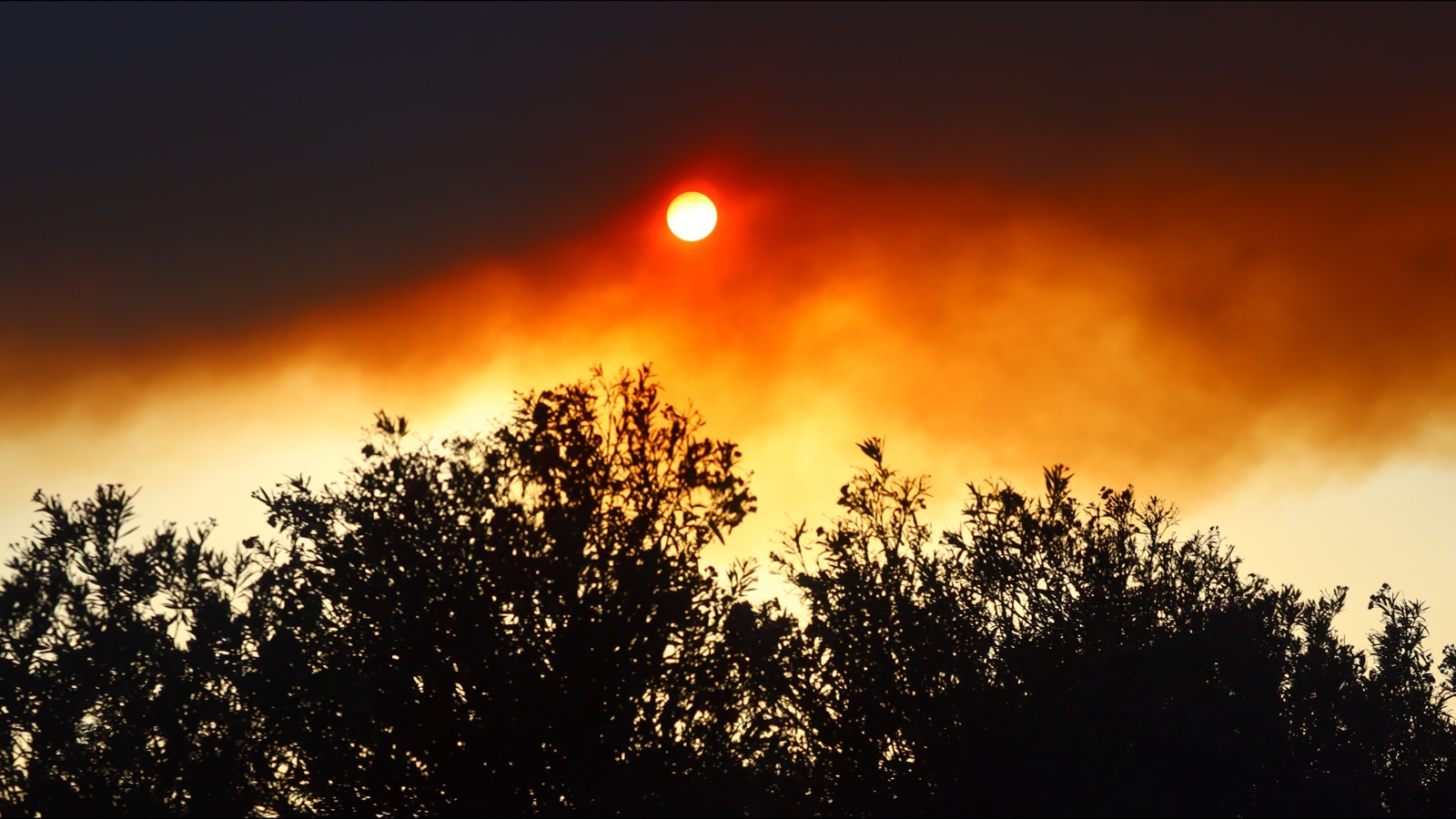
You wake up, check the sky, and it's that colour. Not quite fog, not quite cloud — a flat grey-orange that smells faintly of a campfire. The smoke forecast says it will clear by the afternoon. Your training plan says tempo run, today.
So do you go? The honest answer is: it depends on a number you can look up in ten seconds, and on who you are. Smoke is not a reason to cancel every session, and it is not something you should train through with your head down either. Exercise changes the dose of what you breathe in, and that changes what the guidance means for you specifically.
This is the practical version: how much smoke matters, what the AQI numbers actually mean for training, what the research says about hearts and heart-rate variability, and how to decide session by session.
TL;DR: Exercise raises your breathing rate roughly tenfold, so a run in smoky air delivers far more particles to your lungs than sitting outside in the same air. Check the Air Quality Index (AQI) before you train: under 50 is fine, 51–100 is fine for most people, 101–150 means sensitive groups should cut back or move indoors, 151–200 means everyone should reduce duration and intensity (sensitive groups move indoors), and above 200 nobody should be doing hard outdoor exercise. Wildfire smoke is mostly fine particulate matter (PM2.5), and short-term PM2.5 exposure is linked to reduced HRV, higher resting heart rate and higher blood pressure. If you do train in smoke, keep it short, keep it easy, and watch your recovery data for the next day or two — that is the signal that tells you how much your body minded.
YouTube: Related video
Why exercise changes the whole equation
At rest, an adult breathes somewhere around 6 to 10 litres of air per minute. During moderate running, that can climb to 40 to 60 litres. Hard intervals can push past 100.
More air means more of whatever is suspended in it. If the air contains wildfire smoke, an hour of running delivers a considerably larger dose of particles to the deep lung than an hour of sitting on the same bench. That is not a theory — it is arithmetic, and it is why public health guidance treats "prolonged or heavy exertion outdoors" as a separate, riskier category from simply being outside.
There are three other reasons exercise magnifies smoke exposure:
- You breathe through your mouth. Nose breathing filters and humidifies air. Once you're working hard, you switch to mouth breathing and skip much of that filtering.
- Air goes deeper. Faster, deeper breaths carry particles further into the airways and alveoli, the tiny air sacs where gas exchange happens.
- Blood flow shifts. During exercise, blood is redirected to working muscles and the lungs. Particles that cross into the bloodstream meet a circulatory system operating at full tilt.
None of this means "never exercise when it's smoky." It means the same AQI reading is a bigger deal for a runner doing intervals than for someone walking the dog — and it means intensity and duration are your two dials.
What's actually in wildfire smoke
Wildfire smoke is a moving mixture. What comes out of the fire is not what gets to your lungs hours later, hundreds of kilometres away.
The main ingredients are:
- Fine particulate matter (PM2.5 and PM10) — the smallest particles, under 2.5 micrometres across, are the ones that matter most for health. They are small enough to travel deep into the lungs, and they can cross into the bloodstream.
- Gases — carbon monoxide, nitrogen oxides, and a range of volatile organic compounds.
- Secondary pollution — as smoke drifts over cities it can react with traffic emissions and sunlight to form ozone and new particles, which is why smoke sitting over a dense urban area is often worse than smoke over open country.
PM2.5 is the number your weather app and the AQI are mostly talking about. It travels enormous distances — smoke from Canadian wildfires has regularly pushed air quality in New York, London and northern Europe into unhealthy territory — and it can hang in the air for days.
For context on scale, a 24-hour PM2.5 concentration of 15 µg/m³ is the World Health Organization guideline. An AQI of 150 corresponds to roughly 55 µg/m³, nearly four times that. On bad smoke days, monitors in affected regions have recorded several hundred.
What it does to your heart and nervous system
The respiratory effects of smoke get most of the attention, but the cardiovascular story is where a wearable owner should be paying attention.
A 2020 review of wildfire smoke and cardiovascular health in Particle and Fibre Toxicology describes a consistent pattern: short-term elevations in particle levels are associated with cardiac arrhythmias, worsening of heart failure, and triggers for ischaemic events, particularly in people with existing cardiovascular disease. The proposed mechanisms are inflammation, oxidative stress, endothelial dysfunction, and a shift in autonomic balance toward sympathetic ("fight or flight") activity.
That autonomic shift is measurable in exactly the metrics your watch already tracks. Population studies have repeatedly found that short-term exposure to PM2.5 is associated with reduced heart-rate variability and increased heart rate — the direction that says your nervous system is running more defensive and less recovered. A study using data from the German KORA cohorts summed it up bluntly: short-term exposure to PM2.5 and nitrogen dioxide impaired cardiac autonomic function, reflected in lower HRV and higher heart rate. Meta-analyses in older adults have put the effect per 10 µg/m³ increase in PM2.5 in the region of a fraction of a percent to a couple of percent on measures like SDNN and RMSSD — small for a single day, but real, and it accumulates across days.
Two caveats keep this honest. First, most of this research is observational: it shows associations, not proof that one smoky run damaged your heart. Second, the people at genuinely elevated risk are those with existing heart or lung disease, older adults, pregnant people, children, and anyone with asthma or COPD. For a healthy, fit adult, a single short session in moderately smoky air is not a medical emergency. It is also not free.
Wildfire smoke exposure is also a decent example of a stressor that shows up in recovery data before you feel it. If your overnight heart rate creeps up and your HRV sits below baseline for two or three days after a smoky session, that's information worth acting on, not ignoring.
The AQI decision table
The AQI is a standardised 0–500 scale. For particle pollution, the wildfire-relevant bands and the activity guidance that goes with them look like this:
| AQI | Category | What it means for outdoor exercise |
|---|---|---|
| 0–50 | Good | Fine for everyone. Train as planned. |
| 51–100 | Moderate | Fine for most people. Unusually sensitive individuals may notice symptoms and should consider shortening hard sessions. |
| 101–150 | Unhealthy for sensitive groups | Sensitive groups (asthma, heart or lung disease, children, older adults, pregnancy): reduce prolonged or heavy exertion, or move indoors. Everyone else: shorter and easier than planned. |
| 151–200 | Unhealthy | Everyone: reduce duration and intensity, and avoid hard intervals. Sensitive groups: move exercise indoors. |
| 201–300 | Very unhealthy | Sensitive groups: no outdoor exertion at all. Everyone else: move it indoors, or keep outdoor activity short and very easy. |
| 301+ | Hazardous | Nobody should be exercising outdoors. |
A few things worth knowing about applying this in practice:
- AQI is a 24-hour-ish average for particles, not a live reading. During a smoke event, the real-time concentration can swing fast — a morning inversion can clear by noon, or the other way round. Check the current number, not yesterday's.
- Local beats national. Use the fire and smoke map on AirNow or your local monitoring network, and prefer the closest monitor. Wildfire smoke is patchy; the reading two towns over may be meaningfully different.
- Ozone stacks on top of particles. On hot, sunny days in urban areas, smoke plus traffic emissions means the AQI you see may understate what a hard workout costs you.
- Don't be heroic with a mask. A well-fitted N95 or FFP2 respirator genuinely reduces how many particles you inhale, but it also adds breathing resistance and heat. It's a reasonable tool for a walk or commuting. It is not the right tool for threshold intervals — the breathing load tends to become the limiting factor and the fit degrades as you sweat.
A practical playbook for smoky days
Here's what I'd actually do, in order of preference.
1. Move the session indoors. A treadmill, indoor bike, or gym with decent filtration. Indoor PM2.5 levels are typically a fraction of outdoor levels during smoke events, and running a HEPA purifier in the room you train in pushes them down further. This is the single highest-value swap on a bad day.
2. If you're going outside anyway, cut duration before you cut intensity — but cut both if it's really bad. Easy aerobic work at 30–40 minutes is a far smaller dose than an hour of intervals. Your weekly training plan does not live or die on one session.
3. Train away from roads. Smoke plus traffic emissions is worse than smoke alone. Parks and quiet side streets beat city loops on these days.
4. Avoid the worst windows. Smoke concentrations often peak overnight and in the early morning when the air is still and cool, then mix out through the day. If the AQI is 180 at 6am and 90 at 4pm, the afternoon is the smarter session. On other days, the pattern is reversed — check, don't assume.
5. Keep the length short for vulnerable groups. If you have asthma, use a preventer inhaler as prescribed, carry your reliever, and pay attention to cough, wheeze, chest tightness or unusual breathlessness. Those symptoms mean stop, not push through.
6. Hydrate and don't stack stressors. Smoke is an inflammatory load. If you're also sleep-deprived, sick, or coming off a hard block, that's a poor day to add smoke on top. This is the same judgement call you'd make about training when you're fighting something off.
What your watch will show you
If you do train in smoke, your wearable can tell you how much your body minded — and it's more useful than a vague sense of "that felt grim."
Expect some combination of:
- Resting or overnight heart rate elevated above your normal range for a day or two.
- HRV below your baseline, sometimes for two to three nights, not just one.
- Higher heart rate at a given pace, which is also what happens in heat and at altitude, so treat a single session as ambiguous. The pattern over days is what matters.
- A lower recovery or readiness score the next morning, if your device has one.
The key is the comparison. In Century your overnight heart rate, HRV and recovery score are charted against your own baseline, so a smoke-driven dip is easy to spot against the week around it. If the metrics return to normal within a day, carry on. If they stay suppressed while smoke lingers, keep the sessions easy and short until the air clears — that's your body asking for the swap you were already considering.
If you want the wider context on how environmental conditions move your heart rate, the same logic applies in cold weather running and on hot days: conditions change the cost of a given pace, and your numbers reflect that.
When to stop and get help
Stop exercising and seek medical advice if you experience:
- Chest pain, pressure, or tightness
- Significant shortness of breath at a level that doesn't match the effort
- Wheezing that doesn't settle, or a cough that produces coloured sputum
- Dizziness, fainting, or heart palpitations
- In children: unusual lethargy, coughing that won't stop, or difficulty breathing
Anyone with known heart disease, COPD, severe asthma, or who is pregnant should follow their clinician's advice rather than a generic AQI table. Smoke events are exactly the kind of situation where a personal medical plan beats a blog post.
Bottom line
Wildfire smoke is a real physiological stressor, and exercise increases the dose. But the decision is not binary. Check the AQI, check it again at the time you plan to train, and then adjust the two variables you control: how long, and how hard.
Under 50, train normally. Between 100 and 150, shorten and soften. Above 150, assume an indoor session is the better training decision, and above 200 it isn't a decision at all. Afterwards, let your recovery data tell you whether your body agreed — and if it disagrees for more than a day or two, believe it.
The sessions you move indoors during a smoke week cost you almost nothing. The ones you force through, in air your lungs are actively trying to protect you from, are the ones worth skipping.
Century AI helps you understand your body with a daily health score, recovery score, and sleep insights — using the watch you already wear.