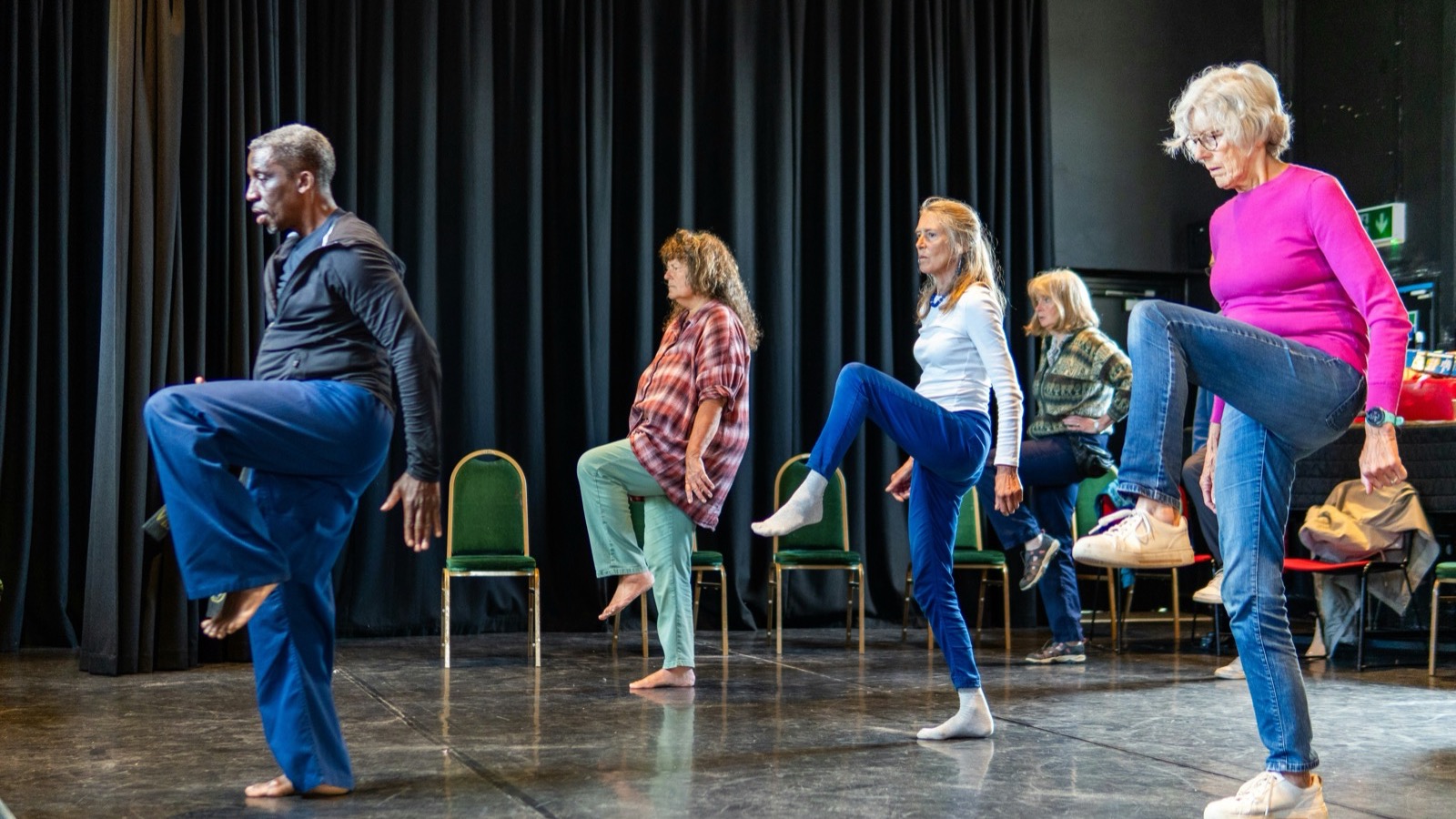
Stand on one leg for ten seconds. That's the whole test.
It sounds too simple to matter, but a 2022 study in the British Journal of Sports Medicine found that people in their fifties to seventies who couldn't complete ten seconds of one-legged standing were 84% more likely to die from any cause over the next seven years, even after adjusting for age, sex, and existing health conditions.
That's a stronger signal than most blood markers your doctor checks, and it costs nothing to measure.
TL;DR: Most adults under 60 should manage 10 seconds on each leg without support. Over 65, around one in three can't, and that's a meaningful warning sign. The test predicts falls and mortality better than many standard clinical measures, and balance is trainable at any age. Two or three short sessions a week is enough to move the needle.
YouTube: Related video
How to do the test properly
The details matter here, because a sloppy test gives you a meaningless number.
- Stand barefoot on a hard, level floor with your arms by your sides.
- Place the front of one foot against the back of the opposite lower leg, like a modified tree pose.
- Keep your gaze fixed straight ahead, not down at your feet.
- Keep the standing foot flat on the floor and still. No hopping, no shifting onto the ball of your foot.
- Start a timer when your foot leaves the floor, and stop it when either foot moves from position, your arms come away from your sides, or you have to step or hop.
- You get up to three attempts on each foot. Best attempt counts.
Do it next to a counter or a wall so you can grab on if you start to fall. You're testing balance, not courage.
Two versions are worth doing:
- Eyes open. This is the version used in the mortality research, and it's the one to track over time.
- Eyes closed. Much harder, and a better probe of proprioception. Expect your time to drop by half or more. It's a useful progression once eyes-open is easy.
What "normal" actually looks like
There's no universal table, because balance norms depend on how you test. But the Araujo study gives a clear picture of failure rates by age in 1,702 adults aged 51 to 75:
| Age band | Share who could not hold 10 seconds |
|---|---|
| 51-55 | ~5% |
| 56-60 | ~8% |
| 61-65 | ~18% |
| 66-70 | ~37% |
| 71-75 | ~54% |
Read that table the other way around and the message is clear. In your early fifties, failing the test puts you in a small minority. By your early seventies, more than half of adults fail. The decline isn't gradual, it roughly doubles every five years.
If you're under 60 and can't manage 10 seconds with eyes open, that's worth paying attention to. It's not a diagnosis, and it doesn't mean something is wrong with you. It does mean your balance system is behind where it should be for your age, and it's worth training.
What the research actually found
The CLINIMEX study followed 1,702 adults (average age 61) for a median of seven years. At the start, each participant attempted the 10-second one-legged stance as part of a broader fitness assessment.
The results:
- 20.4% failed the test at baseline.
- During follow-up, 4.6% of those who passed died, compared with 17.5% of those who failed.
- After adjusting for age, sex, BMI, and comorbidities, failing was associated with a hazard ratio of 1.84 for all-cause mortality.
- Adding the balance test to a model with conventional risk factors improved mortality prediction, meaning it contributed information that age, weight, and disease status didn't already capture.
The researchers were careful about the limits. This was observational, so it can't prove that poor balance causes death. The participants were all white Brazilians, which limits generalisability. And the study didn't capture recent falls, physical activity levels, diet, or smoking, all of which could influence results.
Still, the finding held after adjusting for the big confounders, and the effect size is large enough to take seriously. As Harvard Health put it, the test "is simple, safe, and requires no special equipment," which is exactly why it's attractive as a screening tool.
Why balance predicts so much
Balance isn't one skill. It's the output of several systems working together:
- Vestibular function. Your inner ear's sense of head position and movement.
- Proprioception. Sensors in your feet, ankles, and joints reporting where your body is.
- Vision. Your eyes providing a reference frame.
- Muscular strength. Specifically ankle, hip, and core strength to make corrections fast enough.
- Reaction time and motor control. The nervous system's ability to turn a wobble into a correction.
When you stand on one leg, all five systems have to agree. If any one of them is degraded, you wobble or you step.
That's why balance is such a good proxy for overall physical condition. It's a stress test of the nervous system, the musculoskeletal system, and the sensory system at once. A person who can hold ten seconds has, by definition, intact strength, sensation, and coordination in that leg.
And balance is the mechanism behind falls, which are one of the leading causes of injury and loss of independence in older adults. A hip fracture at 70 often marks the end of independent living, and it usually starts with a stumble that a better balance system would have caught.
The thing most people get wrong
They assume balance is fixed. It isn't.
Balance responds to training like any other physical quality, and the adaptations come fast. Studies of balance training in older adults routinely show meaningful improvements in six to twelve weeks, often with two or three sessions a week of ten to fifteen minutes.
The reason most people don't improve is that they never train it. They run, they lift, they walk, and they assume balance comes along for the ride. It partly does, but running and lifting are mostly sagittal-plane movements with both feet on the ground. They don't demand much single-leg control, especially not with your eyes closed or on an unstable surface.
How to improve it: a four-week progression
You don't need a wobble board or a gym. You need a counter to hold onto when you start.
Week 1-2: build the base
- Stand on one leg, eyes open, 30 seconds per side. Three rounds, most days.
- When 30 seconds is easy, add head turns: slowly look left and right while balancing.
- Hold onto a counter with one fingertip if you need to. Reduce the support as you improve.
Week 3-4: add difficulty
- Eyes closed, 15 seconds per side. Stand near a wall.
- Single-leg stance while brushing your teeth. This is the highest-compliance version of this exercise, because it costs zero extra minutes.
- Heel-to-toe walking, 20 steps forward and back.
- Single-leg Romanian deadlifts with a light weight or no weight, 8 per side.
- Step-downs from a low step, slow and controlled, 8 per side.
Ongoing: make it part of life
- Balance on one leg while waiting for the kettle, the coffee, or the train.
- Take the stairs when you can, and walk down them slowly and deliberately.
- If you play a sport, add single-leg work to your warm-up.
Two sessions a week is enough to maintain. Three is enough to improve.
Balance and the rest of your fitness
Balance doesn't exist in isolation. It's downstream of strength, and upstream of your ability to use that strength safely.
Two related tests are worth adding to the same session:
- The sitting-rising test, which scores how well you can get up from the floor without using your hands. It's another cheap proxy for musculoskeletal fitness and it predicts mortality too. We covered it in detail in our sitting-rising test guide.
- Walking speed and steadiness. Your iPhone already estimates walking steadiness from your gait data, and it's a useful long-term trend even though it's not a balance test. Here's what walking steadiness actually measures.
If you're training for longevity and ignoring these, you're training the engine and skipping the chassis.
What wearables can and can't tell you
Your watch can't measure balance. There's no sensor for it.
What wearables can do is give you the surrounding context:
- Resting heart rate and HRV tell you whether your nervous system is recovered, which affects balance performance on any given day. A bad night's sleep measurably degrades balance.
- Sleep and training load explain why your balance test felt worse on a Tuesday than it did on a Sunday.
- Trends over months show whether your overall physical condition is moving in the right direction, which is the same question the balance test is asking from a different angle.
At Century AI, we think about this as a daily readiness signal plus a long-term trend. The watch tells you how recovered you are. The balance test tells you how well your body can use that recovery. They answer different questions, and you want both.
When to see a professional
Do the test. If you fail it, don't panic, and don't self-diagnose. But do get it looked at if any of these apply:
- You've fallen in the last year, or you've had a near-fall you caught by grabbing something.
- You feel unsteady in the dark, or when turning your head.
- You have numbness, tingling, or weakness in your feet or legs.
- You've noticed a sudden change in balance, especially on one side.
- You take medications that affect blood pressure, balance, or alertness.
- You have dizziness, vertigo, or ringing in your ears.
A physiotherapist can assess vestibular function, proprioception, and strength, and give you a targeted program. A doctor can rule out the medical causes. Balance problems are often treatable, and the earlier you address them the better the outcome.
Left versus right: asymmetry is the interesting part
Most people test one leg, see ten seconds, and stop. Test both.
Almost everyone has a slightly better side, and that's normal. But a large, consistent gap tells you something a single number can't:
- A 30% or larger difference between sides is worth investigating. It usually points to an old ankle sprain, a hip control issue, or a strength imbalance that hasn't been addressed.
- Failing on one side and passing on the other is a unilateral deficit, which matters because walking, stairs, and running are all single-leg activities.
- Both sides failing points more toward a systemic issue: strength, vestibular function, sensation in the feet, or a medication effect.
Asymmetry is also an injury risk factor. If one ankle can't stabilise you for ten seconds, it's the ankle that's going to roll on an uneven pavement.
What throws your result off on any given day
This test is a snapshot, not a constant. Expect it to move around, and don't read a single bad result as decline.
Things that reliably make it worse:
- A poor night's sleep. Sleep loss degrades reaction time and postural control measurably.
- Alcohol the night before. Even modest amounts affect the vestibular system.
- Hard training in the previous 24-48 hours. Fatigued calf and glute muscles make corrections slower.
- Barefoot on a soft surface. Carpet, mats, and rugs all add instability that isn't part of the test.
- Holding your phone, a coffee, or a water bottle. Arms need to stay by your sides.
- A recent cold or inner ear infection. Vestibular symptoms can linger for weeks.
- Time of day. Most people are steadier in the late morning than immediately after waking.
That's why the protocol matters: same floor, barefoot, same time of day, arms down, best of three. Once conditions are standardised, the noise drops and the trend becomes readable.
What to track over time
If you're going to do this test, do it properly:
- Same conditions. Same floor, same footwear (barefoot), same time of day.
- Both legs. Asymmetry matters. A 30% difference between sides is worth investigating.
- Best of three. Balance is noisy; one bad attempt isn't a trend.
- Once a month. Weekly is too noisy to read. Monthly gives you a clean trend line.
- Log it next to your recovery data. If your balance test dips in the same weeks your HRV dips, you've learned something about your body.
The bottom line
Ten seconds on one leg is a cheap, safe, surprisingly informative test. Most adults under 60 should pass it easily. If you can't, that's not a verdict, it's a signal, and it's one of the few signals you can act on immediately with a few minutes of daily practice.
Stand on one leg while your coffee brews. Do it with your eyes closed once that's easy. Retest monthly, and watch the number alongside the rest of your data.
Balance is one of the physical qualities that quietly decides how long you stay independent. It's worth ten seconds of your attention.
Century AI helps you understand your body with a daily health score, recovery score, and sleep insights — using the watch you already wear.