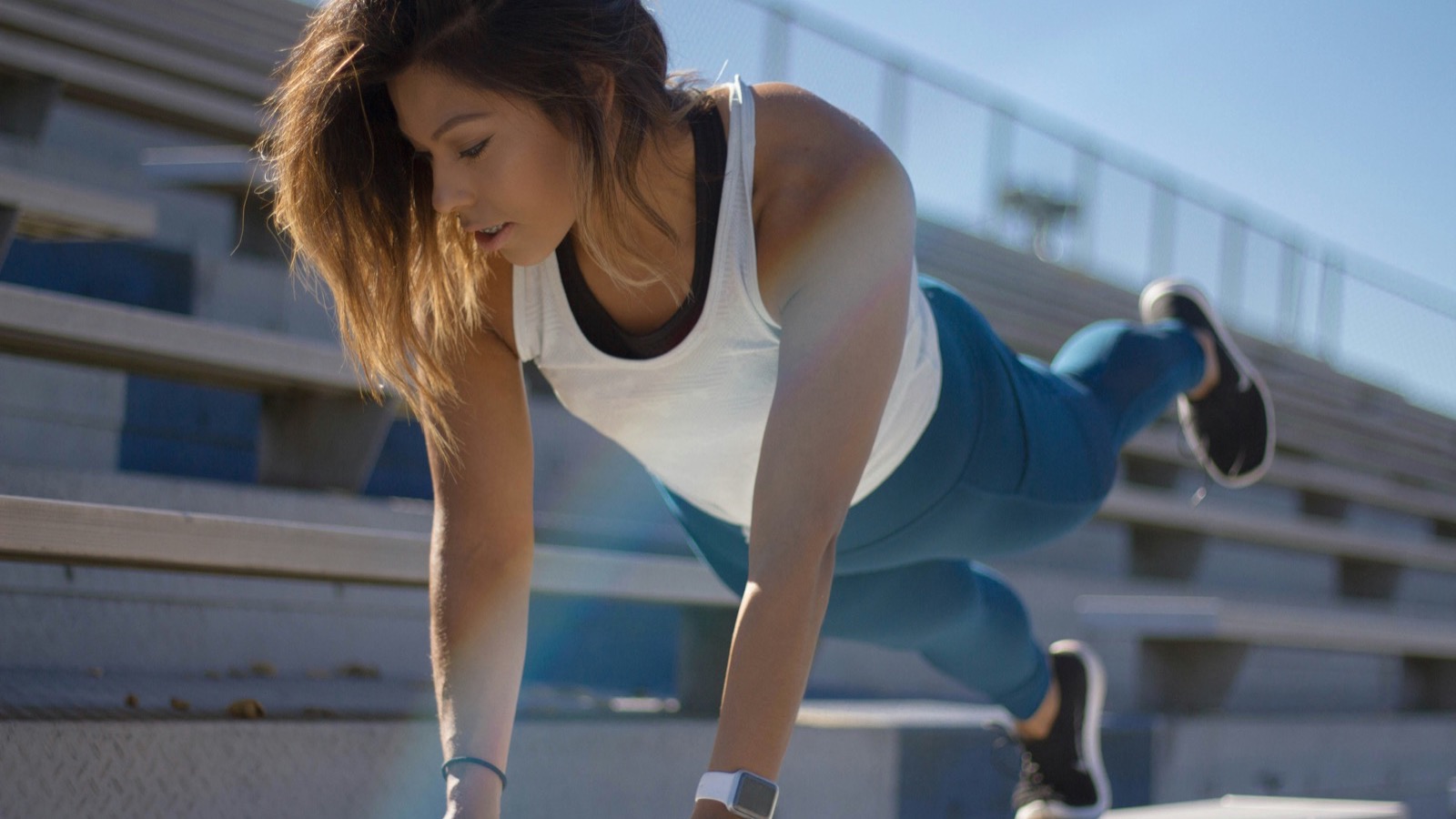
Somewhere along the way, two minutes became the number. It shows up in gym challenges, in fitness influencer reels, in the "can you pass this test" posts. If you can hold a forearm plank for 120 seconds, the internet says your core is solid. If you shake out at 45, something is wrong.
The published data does not really support either claim. And the more interesting finding is that plank time tells you a lot less about your back and your health than the fitness world implies.
TL;DR: There is no official plank standard. In the largest published dataset, 471 college students held a forearm plank for an average of 124 seconds (men) and 83 seconds (women), and athletes beat non-athletes by roughly 40 seconds. In a separate sample of 102 collegiate athletes, the median was 95 seconds for women and 110 for men. Two minutes is a respectable score, not a threshold. Plank time measures isometric trunk endurance, and it appears to be largely unrelated to whether your back hurts: a 2025 study found adults with low back pain actually held planks longer than those without. Test yourself with a fixed protocol, stop when your hips sag rather than when it burns, and train the ratio between front and side planks instead of chasing a number.
YouTube: Related video
What the plank test actually measures
A forearm plank is an isometric hold. Your muscles generate force without changing length, and the limiting factor is not how strong you are in absolute terms. It is how long your trunk muscles can keep producing a submaximal contraction before your position degrades.
That distinction matters more than it sounds. A deadlift tests peak force. A plank tests endurance at low force, plus your tolerance for the discomfort of holding a rigid position while breathing.
Researchers have been using versions of this test for decades precisely because it is cheap, requires no equipment, and is reliable. In the McGill lab's validation work on trunk endurance tests, repeated measurements produced reliability coefficients above 0.97 across five consecutive days and again eight weeks later. That is unusually good for a field test. If you test the same way twice, you are measuring something real.
The catch is what that "something" is. It is not core strength in the sense of how much load you can move. It is not spinal health. It is not a proxy for athleticism. It is endurance of the trunk musculature in one specific position, and it responds quickly to practice. Which is why the numbers move so much between people who train differently.
The numbers, from the two largest published datasets
Two studies give us most of what we know about what "normal" looks like. Both used college-aged samples, which is worth keeping in mind. Neither is a general population norm.
Strand and colleagues (2014) tested 471 college students, 194 men and 277 women, on a prone forearm plank held to volitional or technique failure. Men averaged 124 ± 72 seconds. Women averaged 83 ± 63 seconds.
The same study found that athletes held significantly longer than non-athletes, 123 ± 69 seconds versus 83 ± 63 seconds, with no interaction between sex and athletic status. So being trained matters about as much as being male in this sample, and neither explains the huge spread. A standard deviation of over a minute means plenty of people in that study quit under 60 seconds and plenty held past three minutes.
Chase and colleagues (2014) tested 102 collegiate athletes aged 18 to 25 and reported quartiles rather than just means:
| Percentile | Women | Men |
|---|---|---|
| 25th | 73.5 s | 84 s |
| 50th (median) | 95 s | 110 s |
| 75th | 122.5 s | 135 s |
| Mean | 106 ± 50 s | 118 ± 53 s |
These were self-described athletes, remember. Half of them could not hold two minutes. A quarter of the women could not hold 74 seconds.
So when someone tells you two minutes is the standard for a fit adult, what they are really saying is "above the 75th percentile of a college athlete sample". That is a fine goal. It is not a pass/fail line.
A practical way to read your own number
Given the spread, I would treat the following as a rough map rather than a grading system:
| Hold time | What it usually reflects |
|---|---|
| Under 30 s | Technique breaking down early, or very little recent trunk training |
| 30-60 s | Below the college median, plenty of room to improve quickly |
| 60-90 s | Around the female median in the 471-person sample |
| 90-120 s | Around the male median, solid for most recreational athletes |
| 2-3 min | Top quartile of a college athlete sample |
| Over 3 min | Increasingly a test of grit and breathing tolerance, not tissue capacity |
That last row is the one worth arguing about, and we will get there.
Why two minutes became the magic number
As far as I can tell, the two-minute figure is folklore that inherited the authority of a study. It gets attributed to spinal researcher Stuart McGill, whose actual position is nearly the opposite: his lab work and his public teaching favour short holds, on the order of 10 seconds, repeated several times, with impeccable position. His argument is that long holds mostly test your willingness to endure, and that the capacity you build in a 3-minute hold has poor carryover to the positions where your trunk actually needs to be stable, like carrying, lifting, and running.
There is a coherent logic to that. If the goal is trunk stiffness under load, ten perfect seconds with a neutral spine trains the pattern cleanly. Three minutes of gradually sagging hips trains you to hold a bad position for a long time.
Meanwhile, the endurance test numbers from his 1999 study are about ratios, not absolute holds. In 75 healthy young adults, men could sustain a side bridge for 65% of their extensor endurance time and 99% of their flexion time. Women could sustain a side bridge for only 39% of their extensor time and 79% of their flexion time. Those ratios, not the raw seconds, were the clinical target.
Translated: your side plank capacity relative to your front plank capacity is a more useful signal than your stopwatch.
What a long plank does not tell you
Here is the finding that should temper the whole conversation. A 2025 cross-sectional study of 117 adults, published in the Journal of Clinical Medicine, compared plank endurance in people with and without low back pain. The hypothesis was the obvious one: pain group holds shorter.
The opposite happened. Participants with low back pain held planks significantly longer than those without (p = 0.036).
The authors' interpretation was not that pain makes you stronger. It was that plank duration is a poor proxy for trunk function or disability. People with back pain may brace harder, may be more practiced at enduring discomfort, or may simply have different movement strategies. Whatever the mechanism, the practical takeaway is clear: if your back hurts, a good plank time is not evidence that your back is fine, and a bad plank time is not evidence that it is broken.
This is the same lesson that shows up across fitness testing. A single number from one position tells you about that position and your tolerance for the test. It does not generalise as far as we would like.
The test only works if you run it the same way
If you are going to track this, the protocol matters more than the score. Plank tests are easy to accidentally cheat, and a sloppy test produces numbers you cannot compare week to week.
Do it like this:
- Forearm plank, elbows under shoulders. Hands can be clasped or flat. Feet hip-width or slightly narrower.
- Squeeze glutes, tuck ribs down, keep a straight line from ear to heel. No piking the hips up, no sagging.
- Breathe normally. Holding your breath is a different test. If you cannot breathe, you have already lost the position.
- Stop at the first moment your hips drop or your lower back starts to arch. Not when it burns. When the shape goes.
- Same time of day, same surface, no warm-up set to failure beforehand.
- Best of two attempts, at least 10 minutes apart. Single attempts are noisy.
If you want to be rigorous, film it from the side. Almost everyone thinks their hips are level when they are not. Nothing humbles a plank claim faster than a phone propped against a water bottle.
How to add 30 to 60 seconds in a month
Endurance at submaximal force responds fast. Most people who cannot hold 60 seconds are limited by technique and pacing rather than by muscle. A four-week block is usually enough to see a clear jump.
The structure that works best is unglamorous: frequent, submaximal sets, with one harder day.
Week 1-2: build the habit and the position
- Three sessions per week
- Four sets of 20 to 30 seconds, with 30 seconds rest
- Focus entirely on shape. Stop each set while you still look perfect.
Week 3-4: extend time under tension
- Three sessions per week
- Three sets at 60 to 70% of your current max, 45 seconds rest
- Add one set of a single-leg or long-lever variation (feet further back, or one foot lifted)
Every session, add anti-rotation work
A plank is anti-extension. Your trunk also needs to resist rotation and side bending, and those capacities do not transfer automatically. Two sets of a side plank per side, plus a dead bug or bird dog, covers the pattern in about four minutes.
| Variation | What it changes | When to use it |
|---|---|---|
| Knee plank | Less lever, less load | Building to 60 s |
| Standard forearm plank | Baseline test | Always |
| Long-lever plank (elbows further forward) | Harder at the same time | Once past 90 s |
| Side plank | Lateral trunk endurance | Twice a week |
| Plank with shoulder taps | Anti-rotation plus stability | Once a week |
| Weighted plank | Load progression without time | If you are past 3 min |
If you can already hold three minutes with perfect form, adding time is not the productive next step. Add load, add a lever, or move to a carry variation where the trunk has to stabilise while something else happens. That is closer to how strength shows up in real life.
Where your watch fits, and where it does not
There is no plank metric on any mainstream wearable, and no optical heart rate sensor is going to tell you whether your hips are level. What your watch can do is tell you how your body responds to the session.
Core work is low in cardiovascular cost. A 30-second plank barely moves your heart rate, and a full core session will not produce the kind of training load spike that a run does. That means a hard core day should not show up as suppressed recovery the next morning. If it does, you are either doing far more than you think, or something else is going on: poor sleep, alcohol, illness, a stressful week.
This is where a daily score is useful as a control rather than a coach. Century AI pulls your HRV, resting heart rate, and sleep into a single morning read, so you can see whether the pattern matches what you did. A week of core work with stable HRV and stable resting heart rate is a good sign that the dose is right. A week of it with a drifting resting heart rate usually means the rest of your training is the culprit.
If you are using strength work as a recovery tool rather than a performance goal, the same logic applies. Strength training and HRV covers why lifting can drop your HRV for a day or two even when it is good for you.
Do you actually need to hold a plank?
Honestly? Not necessarily. Planks are a convenient, equipment-free way to train trunk endurance, and trunk endurance is worth having. But the carryover to running, cycling, and lifting is modest compared with actually doing those things. Runners get trunk endurance from running. Lifters get it from bracing under a bar.
Where planks earn their place:
- Rehab and return to training, where you want controlled loading without spinal compression
- Beginners, who need a simple pattern to learn what bracing feels like
- As a test, because it is repeatable and free
- As a filler, on days when you have ten minutes and no equipment
Where they are overrated: as a measure of fitness, as a substitute for loaded strength work, and as a number to compare with strangers on the internet. If you want a test that has actual predictive data behind it, the single-leg balance test and push-up capacity both have more interesting associations than plank time does.
The short version
- Two minutes is a gym benchmark, not a health threshold. In the largest published sample of college students, averages were 124 seconds for men and 83 for women.
- Athletic status moves the number by roughly 40 seconds. Nothing else in the data explains the enormous spread between individuals.
- Plank time is trunk endurance in one position. It is reliable to measure and narrow in what it predicts.
- People with low back pain held planks longer than people without in a 2025 study. Do not use a stopwatch to judge your spine.
- Stop the test when your position breaks, not when it burns. Film it once and you will understand why.
- If you are past three minutes, add difficulty rather than duration.
- Train side planks alongside front planks. The ratio between them is the more useful number.
Test it once. Write the number down. Then spend four weeks on the boring version: short sets, perfect shape, three times a week. You will probably add half a minute, and you will definitely learn more about your trunk than the stopwatch alone can tell you.
Century AI helps you understand your body with a daily health score, recovery score, and sleep insights, using the watch you already wear.