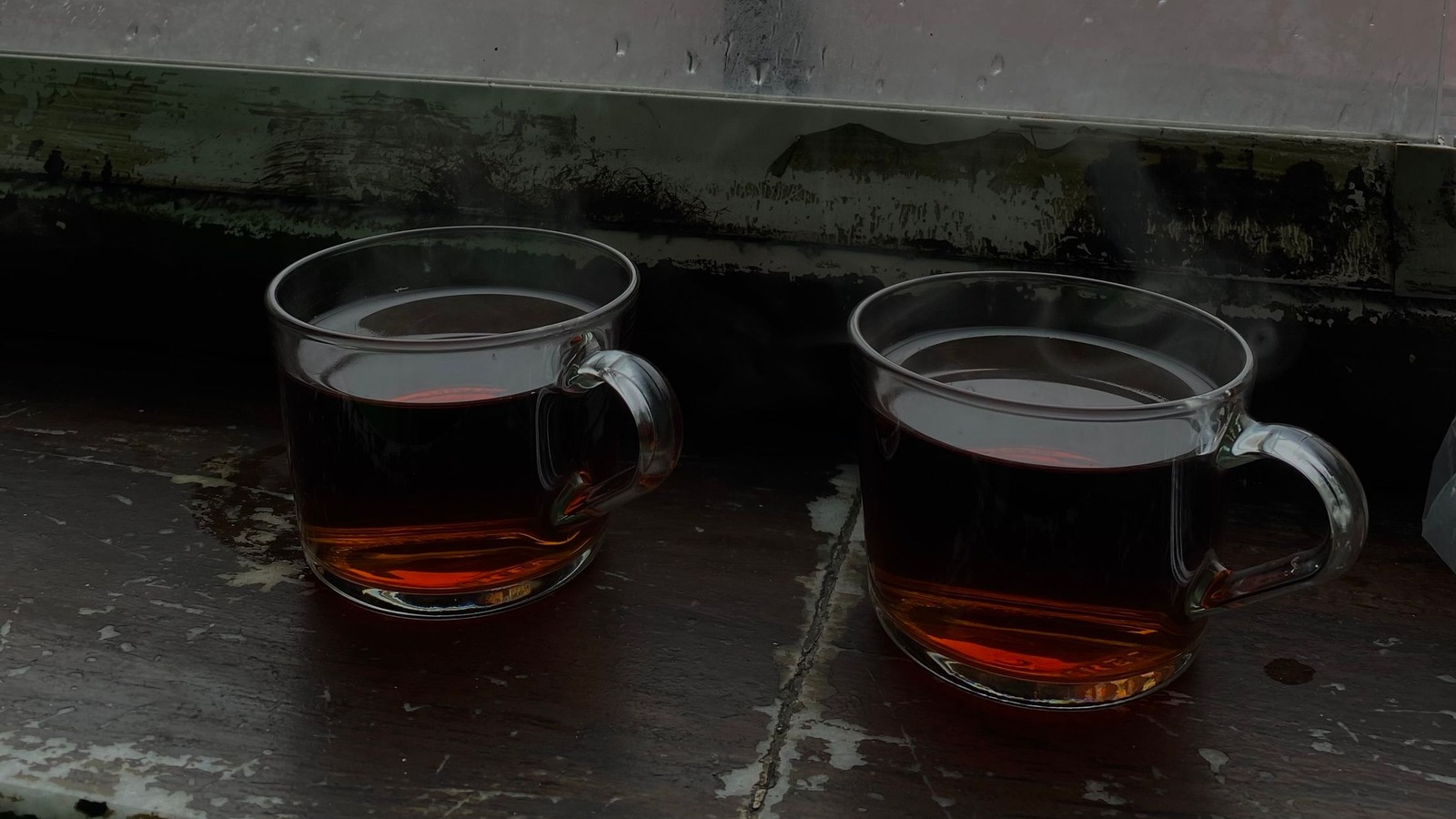
Tea has a reputation that coffee doesn't. People describe it as calmer. Less jittery. Easier to drink in the afternoon without paying for it at midnight. Some of that is just the lower caffeine dose, but not all of it, and the reason usually comes down to one molecule: L-theanine.
L-theanine is the amino acid that makes green tea taste slightly savoury and, according to a growing pile of trials, takes some of the edge off the caffeine sitting next to it. It's now sold on its own as a capsule for stress and sleep, usually at 200 mg, which is roughly the theanine content of a small pot of tea rather than a single cup.
So does it work for sleep? Sort of, and the "sort of" is the interesting part.
TL;DR: L-theanine is a non-protein amino acid found almost exclusively in tea. It's not a sedative. It appears to raise alpha brain wave activity and take the edge off a stress response, which is why it's marketed for sleep. A 2025 systematic review of 13 trials (550 people) concluded that 200–450 mg per day is safe and appears to help sleep, with the clearest signals on sleep latency, sleep quality and how refreshed people feel on waking. The trials are small, several used self-reported outcomes, and one of the more flattering ones was funded by a tobacco company. The realistic use case is mild, stress-driven difficulty falling asleep, not insomnia, apnoea or a body clock problem. The dose in the studies is 200 mg, taken 30 to 60 minutes before bed.
YouTube: Related video
What L-theanine actually is
L-theanine is a non-protein amino acid. That phrase matters: it's not one of the twenty building blocks of muscle, so it isn't doing nutritional work. Your body treats it as a signalling molecule rather than as food.
It occurs naturally in Camellia sinensis, the tea plant, where it's thought to contribute to the savoury umami taste. It's also found in a couple of edible Boletus mushrooms, but in amounts too small to matter. For practical purposes, tea is the only dietary source.
A brewed cup of green tea contains something in the range of 5 to 40 mg, depending on leaf grade, how much leaf you use, water temperature and steep time. Matcha, where you drink the powdered leaf, gets you more. Supplement capsules are typically 100 to 200 mg, which is why the supplement does something a single cup often doesn't.
It's also worth knowing what theanine is not. It's not a sedative. It doesn't bind to GABA-A receptors the way a benzodiazepine does, even though a lot of supplement copy implies that. It crosses the blood-brain barrier, it's structurally similar to glutamate, and it seems to nudge the balance between excitation and inhibition without knocking you out.
That distinction explains the most common complaint in reviews of theanine products: "it didn't make me sleepy." Correct. It isn't supposed to.
What the sleep evidence actually shows
The best single source is a systematic review published in Nutritional Neuroscience in late 2025. The authors pulled every trial that gave L-theanine on its own and measured a sleep outcome, and ended up with 13 studies covering 550 people, doses from 50 to 900 mg per day. Eleven were randomised controlled trials; two were single-arm and open-label, which is a much weaker design.
The conclusion: supplementation with 200 to 450 mg per day "appears to be a safe and effective way to support healthy sleep in adults." Beneficial effects showed up on both objective and self-reported measures, including:
- how long it took to fall asleep
- sleep maintenance, meaning how often people woke up
- sleep efficiency, the ratio of time asleep to time in bed
- how satisfied people were with their sleep
- how refreshed and recovered they felt on waking
That's a coherent set of outcomes, and it lines up with what the earlier stress literature found. A separate systematic review of nine randomised trials, published in Plant Foods for Human Nutrition in 2020, concluded that 200 to 400 mg per day "may assist in the reduction of stress and anxiety in people exposed to stressful conditions." Both reviews end with the same caveat: the trials are small, short, and the field needs better ones, including trials in people with actual clinical insomnia.
Here's the part most supplement articles leave out. The 2025 review's authors are affiliated with British American Tobacco's research and development division. That doesn't make the findings wrong, and the review is methodologically normal, but tobacco companies have a long commercial interest in nicotine alternatives and in "calming" products. Read it as one input, not as the final word.
The trial you'll see quoted most often
A 2019 randomised, double-blind, placebo-controlled crossover trial in Nutrients is the one cited in nearly every theanine article, and it's worth knowing exactly what it did.
Thirty healthy adults, average age 48, took either 200 mg of L-theanine or a placebo for four weeks, then crossed over to the other condition. The main sleep measure was the Pittsburgh Sleep Quality Index, a validated questionnaire rather than a sleep lab.
Results after four weeks of theanine:
- Overall sleep quality score improved (p = 0.013).
- The sleep latency subscale improved, meaning people reported falling asleep faster.
- Sleep disturbance improved, meaning fewer wakings.
- Use of sleep medication dropped, compared with placebo.
Anxiety and depression questionnaire scores also fell, and verbal fluency improved. That last one is a nice finding but a distraction from the sleep question.
Two caveats. Thirty people is a small trial, and the theanine and placebo tablets were supplied by the manufacturer, Taiyo Kagaku, whose employees are co-authors. Again, not disqualifying, just context. The effect sizes here are modest. Nobody in these trials went from three hours of sleep to eight.
Why it might help you sleep at all
The mechanism story has three layers, and they're not equally solid.
The solid one is alpha waves. Several small EEG studies have found that theanine increases alpha wave activity in the 8 to 12 Hz range, the pattern associated with relaxed wakefulness rather than sleep. That's a real, replicated-ish finding. It fits the subjective reports: people feel calmer and more alert at the same time, which is a strange combination until you've tried it.
The plausible one is the stress axis. If theanine blunts the sympathetic and cortisol response to a stressor, and your sleep problem is "my brain won't stop running the meeting from this afternoon," then reducing that arousal should shorten sleep onset. That's a chain of inference, but the stress-trial results make it a reasonable one.
The weak one is "it boosts GABA." You'll see this everywhere. Most of the direct GABA evidence is from animals or from cell models, and the human data is indirect. Your brain's inhibitory system is not a bucket you top up with a capsule.
This is exactly the same fork in the road as glycine, which appears to work on sleep onset through core temperature rather than through sedation. Different lever, similar modest effect. If you want the temperature route instead, my glycine for sleep breakdown covers the polysomnography study and why the architecture result is the interesting part.
Where theanine fits next to magnesium and ashwagandha
The sleep supplement market is crowded and the supplements are not interchangeable. Rough guide:
| Supplement | Best evidence for | Realistic effect | Where it falls short |
|---|---|---|---|
| L-theanine | Stress-driven sleep onset, daytime calm | Small to modest | Insomnia, apnoea, circadian problems |
| Magnesium glycinate | Deficiency correction, mild relaxation | Small, larger if you were low | Will not fix a schedule problem |
| Ashwagandha | Perceived stress, cortisol over weeks | Modest, needs 6+ weeks | Long-term safety data thin |
| Glycine | Falling asleep faster, core temperature | Modest, one good lab study | Maintenance insomnia |
| Melatonin | Circadian shifting, jet lag | Real, but dose-dependent | Not a general sleep aid |
Theanine's honest niche is the person who lies down tired and then thinks for forty minutes. It's not the person who wakes at 3 a.m. every night, and it's not the person whose bedtime moves by two hours every weekend.
If your data shows a stress pattern specifically, including a resting heart rate that stays elevated into the evening, how stress shows up in HRV is the better starting point.
Dose, timing, and the caffeine trap
The trials cluster around 200 mg, and the review's effective range runs to 450 mg. Start at 200 mg and don't expect much from 50 mg.
Take it 30 to 60 minutes before bed if you're using it for sleep. For daytime stress, 100 to 200 mg in the early afternoon works and won't make you drowsy. There's no strong evidence for cycling it, and no known tolerance effect.
Now the trap. A lot of people try to get their theanine from green tea at night, which is a caffeine delivery system with a small amount of theanine attached. Green tea has roughly 30 to 50 mg of caffeine per cup, and caffeine's half-life is around five hours, with a wide range between people. A cup at 9 p.m. leaves a meaningful fraction in your system at 1 a.m. If you're a slow metaboliser, it leaves more.
Theanine and caffeine together do genuinely work as a focus stack, which is why matcha feels different from coffee. That's an afternoon tool. At night, use the capsule or skip it. If you're mapping your own caffeine ceiling, the caffeine cutoff experiment is a better use of a fortnight.
How to test it on yourself, properly
The supplement industry runs on "I slept great last night." Night-to-night sleep data is noisy enough that a single good night proves nothing. Here's the version that gives you an answer.
Weeks 1 and 2: 200 mg L-theanine, 45 minutes before bed, every night. Keep your bedtime and wake time fixed, and no alcohol on test nights.
Weeks 3 and 4: stop. Same schedule otherwise.
Then compare the two halves of the month using seven-day averages, not individual nights:
- sleep onset latency and sleep efficiency, if your watch reports them
- overnight HRV and resting heart rate
- the number of times you remember waking
- a one-line morning note on how rested you feel
A real effect shows up as a shift in the average, not a single great Tuesday. If the on-weeks are consistently better by a meaningful margin, you've found something worth keeping. If the averages overlap, you've saved yourself a monthly subscription.
This is the same logic I use for every recovery metric: trends over single scores. A number that moves one night is a data point. A number that moves for two weeks is a signal.
What it won't do
Worth being blunt, because the marketing isn't.
- It won't fix sleep apnoea. If you snore heavily, wake gasping, or feel wrecked after eight hours in bed, that's a clinical conversation, not a supplement decision.
- It won't fix nocturia. Waking to pee is a fluid-timing and sometimes a prostate or pelvic-floor issue.
- It won't shift your body clock. For jet lag and shift work, light exposure and timing do the work.
- It won't beat CBT-I for chronic insomnia. Cognitive behavioural therapy for insomnia is the first-line treatment and beats every supplement in the literature. If you've had three months of bad sleep, that's the intervention with the evidence behind it.
- It won't make you drowsy on demand. If you're looking for that, you're looking at the wrong molecule.
Safety and who should skip it
L-theanine has a good safety profile. Trials have run doses up to 900 mg per day for weeks without notable adverse events, and it's a normal component of tea. Reported side effects are rare and mild, mostly headache in a small number of people.
Three groups should be a little careful. If you take blood pressure medication, note that theanine has been associated with small reductions in blood pressure, so the combination is worth mentioning to your doctor. If you're pregnant or breastfeeding, the supplement-specific data is thin, and tea is the more studied delivery route in that context. And if you're on anything sedating, don't stack a new "calming" supplement on top without asking.
One more practical note: if 200 mg makes you feel flat, foggy, or emotionally blunted, stop. A small number of people report that, and there's no reason to push through it for a modest sleep benefit.
The short version
- L-theanine is the calming amino acid in tea, and the only meaningful dietary source is Camellia sinensis.
- It's not a sedative. It raises alpha wave activity and appears to soften the stress response.
- A 2025 systematic review of 13 trials found 200–450 mg per day safe and helpful for sleep, strongest on sleep latency and how refreshed people feel.
- The trials are small, short, and one influential review was industry-adjacent. Modest effects, honest caveats.
- Best case: stress-driven difficulty falling asleep. Worst case: anything structural.
- Dose is 200 mg, 30 to 60 minutes before bed. Don't chase it with green tea at 9 p.m.
- Test it as two weeks on, two weeks off, and compare averages.
- Chronic insomnia has a better first-line answer, and it isn't a capsule.
The appeal of theanine is that it's specific. One mechanism, one narrow part of the sleep problem, a food-level dose, and a testable effect in your own data within a month. That's a much better proposition than "supports deep sleep" with a stock photo of a lavender field behind it.
This isn't medical advice. If you're taking prescription medication or managing a health condition, talk to a clinician before adding supplements.
Century AI helps you understand your body with a daily health score, recovery score, and sleep insights — using the watch you already wear.