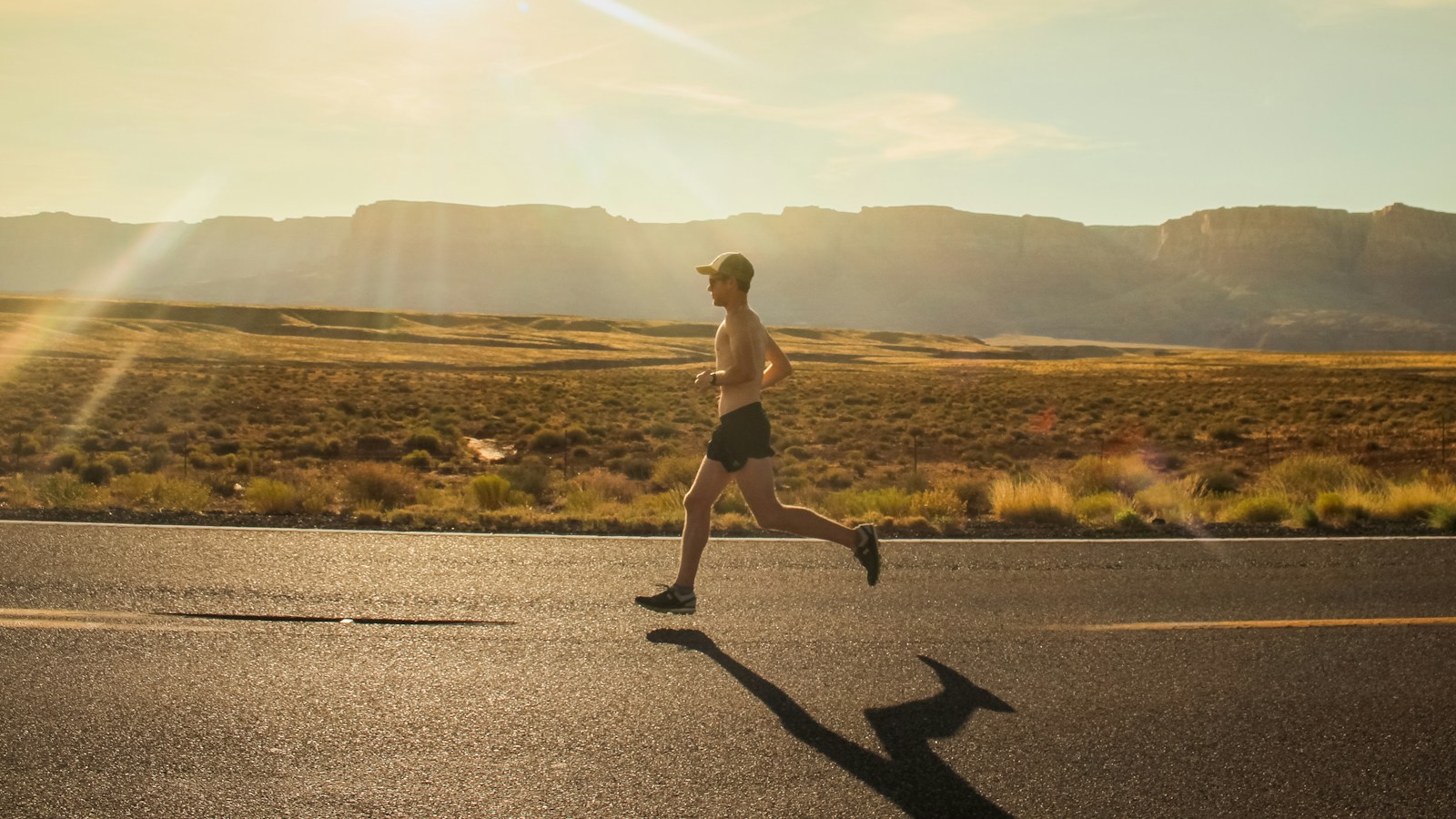
The first hot session of the year is always humbling. Same pace as last week, same route, same legs, but your heart rate sits 15 beats higher and the effort feels two zones harder. Nothing is wrong with you. You're watching thermoregulation compete with locomotion for the same blood.
That gap between what your watch says and what your legs are doing is the most confusing part of training in the heat. It's also the reason heat acclimation exists as a training method: expose yourself to heat deliberately for a week or two, and the same pace starts costing you less again.
This is what's actually happening in your body when the temperature climbs, what changes when you adapt, how long it takes, how fast it fades, and how to build heat tolerance without turning your training week into a survival exercise.
TL;DR: In the heat, blood is diverted to your skin for cooling, so less returns to the heart each beat. Stroke volume drops, and heart rate rises to keep cardiac output up — often 10-20 bpm higher at the same pace before you're acclimated. Dehydration makes it worse: roughly every 1% of body mass lost to sweat adds about 3 bpm to your heart rate. Heat acclimation — repeated exercise in the heat, 60-90 minutes a day for 5-14 days — expands plasma volume by roughly 5-15%, lowers heart rate at a given workload, lowers core temperature, and makes you sweat earlier and more efficiently with less sodium lost. Most cardiovascular adaptations appear within the first week but decay quickly without heat exposure, so treat heat as a training load you schedule, not a background condition you endure.
YouTube: Related video
Why your heart rate is higher in the heat
Your body has two jobs when you exercise in the heat, and they compete for the same blood supply.
The first job is delivering oxygen to working muscle. The second is dumping heat, which means sending blood to the skin so it can be cooled by sweat evaporation. In cool conditions, skin blood flow during exercise is modest. In the heat, it can climb to several litres per minute — a serious slice of your total cardiac output, taken away from the muscles that are asking for it.
Two things follow from that. First, less blood returns to the heart between beats, so stroke volume falls. To hold cardiac output steady, your heart has to beat faster. That's the higher heart rate at the same pace. Second, your heart is also working against a wider, more dilated network of skin vessels, which is its own cardiovascular load.
Then dehydration stacks on top. Sweat is drawn from your plasma, so plasma volume drops, blood gets thicker and stroke volume falls further, and heart rate drifts upward as the session goes on. This is cardiac drift, and it's why the same pace that felt fine at minute 10 can feel like a race effort at minute 60. The ACSM fluid replacement position stand puts a number on it: for every 1% of body mass lost through sweating, heart rate rises by roughly 3 bpm and core temperature climbs with it. A one-hour session in the heat can cost you 1-2 litres.
There's an ironic flip side worth knowing. Because the heat response dilates your skin vessels, heart rate can be slightly lower at the same pace once you've been in the heat for a while and you're well hydrated — the same reason heart rate behaves differently in the cold. Don't build a theory on a single session. Look at the pattern.
What actually changes when you acclimate
Heat acclimation is not "getting used to feeling bad." It's a measurable set of adaptations, most of which are cardiovascular and thermoregulatory.
| Adaptation | What changes | Practical effect |
|---|---|---|
| Plasma volume | Expands roughly 5-15% | More blood to circulate, so stroke volume holds up better |
| Heart rate at a fixed workload | Falls, commonly 5-10 bpm | The same pace costs less cardiovascular effort |
| Core temperature | Resting and exercising core temp drop | More headroom before you hit your thermal ceiling |
| Sweat onset | Starts earlier, at a lower core temperature | You begin cooling before heat builds up |
| Sweat rate | Higher maximum sweating capacity | More evaporative cooling per minute |
| Sweat composition | Less sodium per litre of sweat | Better electrolyte retention over long sessions |
| Skin blood flow | More efficient, better distributed | Cooling with less cardiovascular cost |
The practical marker most people notice first is the one your watch already records: heart rate at a fixed pace. If a 10 km easy run at 5:30/km cost you 152 bpm in June's first heatwave, two weeks of acclimation should pull that down — not to winter numbers, but lower. Resting heart rate also tends to drop slightly as plasma volume expands.
Those adaptations aren't only useful in the heat. Lorenzo and colleagues showed that 10 days of heat acclimation improved both VO2 max and endurance time-trial performance in cool conditions as well as hot ones. Heat training is often described as the poor man's altitude camp, and the plasma volume expansion is a big part of why.
How long it takes, and how fast it fades
The good news is that heat acclimation is fast by training standards.
- Day 1-3. Heart rate and perceived effort at a given workload start improving. Plasma volume begins to move. Most of this early gain is hydration and cardiovascular, not yet sweating.
- Day 5-10. The bulk of adaptation lands. Sweat rate and sweat onset improve, heart rate at fixed workload settles lower, core temperature during exercise drops.
- Day 10-14. Diminishing returns, but some athletes keep improving slightly, especially with a fully isothermic protocol where core temperature is deliberately held around 38.5°C for about an hour.
The bad news is that decay is faster than most people expect. Cardiovascular adaptations — the plasma volume and lower heart rate — fade within roughly one to two weeks without heat exposure. Sweat adaptations persist longer, sometimes several weeks. That's why the practical advice from the heat consensus literature is maintenance, not accumulation: once you're acclimated, one heat exposure every five to seven days is usually enough to hold most of it. If you're heading somewhere hot, the ideal timing is a heat block that finishes right before you travel.
Two ways to build it: train in it, or add heat to training
Option 1: Continuous exercise-heat exposure. The classic protocol is 60-90 minutes of moderate-intensity exercise in the heat per day for 5-14 days. Keep the intensity genuinely moderate for the first few sessions — the heat is the training stimulus, and stacking a hard session on top of the heat load is how acclimation blocks turn into overreaching. Most people can't hold their usual paces here, and that's expected.
Option 2: Controlled hyperthermia (isothermic) protocols. Instead of fixing the workload, you fix the body temperature target: raise core temperature to roughly 38.5°C and hold it there for about 60 minutes by adjusting clothing, intensity or the environment. This produces more complete adaptation per day and is useful if you can't get real heat. It's also more stressful, so it belongs in a block where you're not chasing peak performance.
Option 3: Passive heat (sauna, hot bath). Post-exercise hot water immersion and sauna sessions can drive some acclimation on their own, mostly through repeated heat stress rather than exercise specificity. The 2025 quantitative review of acclimation kinetics makes the useful distinction: exercise-heat protocols adapt you to exercising in the heat, passive heating gives you a partial version of the cardiovascular side. If you already use sauna for recovery, it's a reasonable proxy — but it isn't a full substitute.
If you have a choice, do the heat work indoors on a treadmill or bike, where you can control output, hydration and airflow. Outdoor heat is more variable and the sunrise sessions are the only ones a lot of people can realistically fit in.
Heat is a training load, not a free bonus
This is the part that gets missed. Adding heat to a session makes that session harder, and harder training costs recovery. If you add heat on top of an already full training week and change nothing else, you will not get whatever benefit you were hoping for — you'll get a more fatigued version of the same athlete.
The useful framing: heat is a load variable. Ask when it will cost you the least and give you the most.
- Good timing: base phases, early in a training block, off-season, or as preparation for a hot race or holiday.
- Bad timing: the peak weeks of a race block, during a heavy strength phase, or in the days before a key session or race.
- Practical rule: for the first 3-4 heat sessions, expect fatigue to linger. Drop the volume or intensity of the other hard sessions in those days. After that, most people adapt and can resume normal training.
Expect your wearable to agree. Heat exposure typically suppresses HRV and raises resting heart rate for a day or two, especially early in a heat block — the same signature hard training leaves. That's not a sign you're broken; it's a sign you're loaded. What matters is whether you return to baseline within 24-48 hours. If your resting heart rate is still up 5+ bpm on day three of a heat block, you've added more heat than your current training can absorb.
What to watch in your wearable
You don't need a lab to track acclimation. Four numbers tell you most of what matters:
- Heart rate at a fixed pace or power. The clearest marker. Compare like with like: same route, similar time of day, similar temperature if possible.
- Resting heart rate trend. Should drift down slightly as plasma volume expands. A sustained rise means the heat load is outpacing your recovery.
- HRV trend. Expect a dip early in a heat block and a return to baseline. Waking HRV is noisy day to day — judge the multi-day trend, not one morning.
- Heart rate recovery. How fast your heart rate drops in the minute after you stop. Better recovery after the same session is a good sign that the cardiovascular side of acclimation is working.
One caveat: wrist optical sensors struggle more when your skin is hot and sweaty, and they can underread during high-intensity intervals. If your heart rate trace looks physically improbable in a swim or a sweaty interval session, trust effort and talk-test over the number — this is the same problem that shows up in heart rate drift during long zone 2 work.
A simple 10-day heat block
If you want the adaptation without overthinking it:
| Day | Session | Notes |
|---|---|---|
| 1 | 45 min easy, in heat | Expect +10-15 bpm. Cap intensity at conversational |
| 2 | Rest or easy cool session | Let the load settle |
| 3 | 60 min easy, in heat | Hydrate 500-750 ml/h |
| 4 | Normal training, no heat | Keep the training quality |
| 5 | 60-75 min easy, in heat | Sweat onset should start feeling earlier |
| 6 | Rest | Sleep is the adaptation window |
| 7 | 60 min, heat, last 20 min moderate | Notice HR at the same pace |
| 8 | Normal training, no heat | |
| 9 | 60-90 min easy, in heat | Largest plasma volume gains around now |
| 10 | Easy, in heat, then maintain | One heat session every 5-7 days holds it |
Throughout: hydrate with sodium, not plain water alone, don't chase your usual paces, and keep the hard sessions hard and separate from the hottest days.
Safety, briefly but not skippably
Heat illness is a spectrum, and it escalates quickly. Stop and cool down if you get any of these: a headache that builds, nausea, dizziness, goosebumps or chills during exercise, confusion or unusual irritability, or the sudden sensation of feeling cold and clammy. The stop-sweating stage is a late sign, not the first one.
Practical guardrails: exercise earlier or later, use shade and airflow, wear light and loose clothing, match fluid replacement loosely to sweat losses, and be conservative if you're new to heat, unwell, sleep-deprived, on medication that affects sweating or heart rate, or drinking alcohol. Heat acclimation works best when you're patient, and it stops working entirely if you end up in a medic tent.
The short version
- Heart rate rises in the heat because skin blood flow and muscle blood flow compete, stroke volume falls, and heart rate compensates. Dehydration adds roughly 3 bpm for every 1% of body mass lost.
- Heat acclimation is a set of measurable adaptations: plasma volume up 5-15%, heart rate at fixed workload down 5-10 bpm, lower core temperature, and sweating that starts earlier and costs you less sodium.
- Most adaptation arrives in 5-14 days of repeated exposure; cardiovascular gains fade within one to two weeks without heat, sweat adaptations last longer.
- Exercise-heat protocols (60-90 min/day) are the most specific; controlled hyperthermia is more potent but more taxing; sauna and hot baths are a partial substitute.
- Heat is a training load. Schedule it in base phases, not peak weeks, and expect 24-72 hours of suppressed HRV and raised resting heart rate.
- Track heart rate at a fixed pace, resting heart rate, HRV trend and heart rate recovery. Those four tell you whether it's working.
- Hydrate with sodium, don't chase winter paces, and stop at the first signs of heat illness.
Vector-based training zones, heart rate trends and recovery scores all live in one place in Century, which turns the data from the watch you already wear into a daily read on how much load you can actually absorb. If you're also tracking how heat shows up in your baseline metrics, why summer ruins your HRV and resting heart rate covers the interpretation side.
Century AI helps you understand your body with a daily health score, recovery score, and sleep insights — using the watch you already wear.