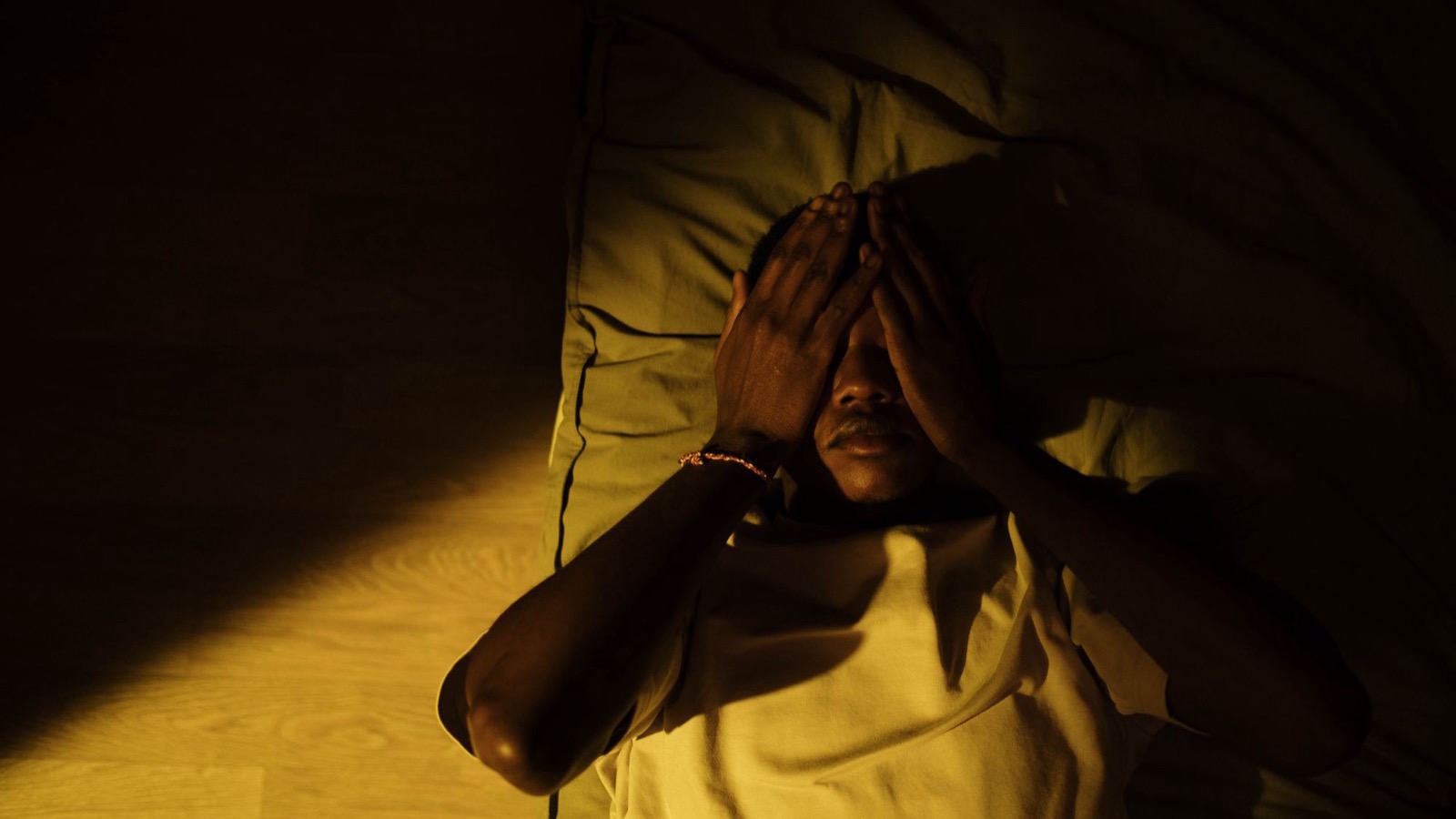
You've been tired all evening. You finally get into bed, pull the duvet up, and within a minute your heart is thumping hard enough that you can feel it in your throat. You lie completely still and count. Nothing hurts. You're not dizzy. But now you're wide awake and quietly convinced something is wrong.
This is one of the most common things people search at 1am, and the honest answer is layered. Sometimes it's a completely normal cardiovascular response to changing position. Sometimes it's a harmless extra beat that you simply couldn't feel while you were upright and distracted. And sometimes it's the first clue to something worth investigating properly.
Here's how to tell the difference, and how to use the watch on your wrist to do it without turning it into another source of anxiety.
TL;DR: Lying down increases venous return and stroke volume, which triggers a rapid reflex adjustment in heart rate. That reflex is normal, and an early beat or a brief thump is usually benign. Palpitations are the second most common reason for a cardiology visit, and about a third of cases turn out to be psychosomatic, with atrial fibrillation (16%) and supraventricular tachycardia (10%) making up most of the cardiac causes. Position changes, left-side lying, alcohol, late meals, caffeine, dehydration, and sleep apnea all make nighttime awareness worse. Get checked if palpitations come with fainting or near-fainting, chest pain, breathlessness, a sustained heart rate above 120 at rest, or a family history of sudden cardiac death.
YouTube: Related video
What actually happens when you lie down
Standing up is the famous postural challenge, but lying down is a hemodynamic event too. When you go from upright to horizontal, gravity stops pulling blood into your legs and it flows back toward the chest instead. Venous return rises, the heart's chambers fill more, stroke volume goes up, and blood pressure nudges higher.
Your body doesn't want higher pressure, so the baroreflex kicks in: heart rate and vascular tone adjust within a few beats to keep things stable. Older studies of the immediate heart rate response to lying down found a consistent biphasic pattern, a brief acceleration over the first few beats followed by a slowing that settles over the next twenty to thirty beats. The early part is vagally mediated; the later part is mainly sympathetic.
In practice this means it is completely normal to feel your heart change tempo for the first minute or two after you get into bed. What you're feeling is a real, measurable reflex, not your imagination and not a sign that your heart is failing.
Posture also shifts your autonomic balance more broadly. Studies comparing supine, prone, and seated positions in healthy young adults show clear differences in heart rate, blood pressure, and HRV components depending on position, which is part of why HRV readings taken lying down aren't directly comparable to readings taken sitting up.
Why it feels so much worse at night
Three things amplify the sensation after dark.
Attention. During the day your heart is doing the same thing, but you're talking, walking, working. At night the room is silent, your body is still, and there is nothing competing for your attention except the thumping in your chest.
The left side. Lying on your left side brings the heart closer to the chest wall, which makes the impulse easier to feel. This is a mechanical effect of proximity, not a sign of trouble. Rolling onto your right side or your back often settles it within seconds.
The quiet nervous system. Vagal tone rises at night, which slows the average rate but can also make isolated extra beats more noticeable. Ventricular premature contractions in particular are known to cluster at rest and during quiet periods, and disappear when you're active.
The triggers that show up most often
Palpitations at rest have a fairly well-defined shortlist. The AAFP review of palpitations puts the frequency of causes at roughly 31% psychosomatic, 16% atrial fibrillation, 10% supraventricular tachycardia, 6% medication or illicit substances, 4% systemic disease, 3% structural heart disease, and 2% ventricular tachycardia. That distribution explains why most people who feel their heart at night end up with a benign explanation.
The common nighttime-specific triggers:
- Alcohol. A glass or two of wine at dinner is one of the most reliable ways to get a racing heart at 2am. It also lowers HRV and raises overnight heart rate, which you can see in the data.
- Late, large meals. Digestion increases splanchnic blood flow and sympathetic activity, and reflux can mimic or trigger chest awareness when you lie flat.
- Caffeine after mid-afternoon. Caffeine's half-life is long enough that an afternoon coffee is still active at bedtime for many people.
- Dehydration and electrolyte shifts. Low fluid volume makes the heart work harder per beat, and the effect is more noticeable at rest.
- Anxiety and panic. Adrenergic surges produce exactly the sensation of a pounding heart, often with a jolt awake and a hot flush.
- Sleep apnea. Repeated breathing pauses cause oxygen dips and sympathetic surges that wake people with a racing heart, often with sweating.
- Anemia, thyroid disease, and low magnesium or potassium. All of these increase the awareness of a forceful beat, and all are detectable with simple blood tests.
- Medications. Decongestants, some inhalers, thyroid replacement, and stimulant medication are common culprits.
If your heart rate jumps specifically when you stand rather than when you lie down, that's a different pattern and worth reading our guide to why your heart rate spikes when you stand up.
Is it dangerous?
Most of the time, no. But the word "most" is doing real work here, and the risk isn't evenly distributed.
The AAFP review makes two points that are directly relevant to the nighttime version of this problem. First, people with a history of cardiovascular disease, palpitations at work, or palpitations that affect sleep have an increased risk of a cardiac cause. Second, a family history of arrhythmia or early cardiac death, abnormal physical findings, or an abnormal ECG should prompt a deeper evaluation.
That first point is worth sitting with, because it cuts against the reassurance you might be looking for. If palpitations are consistently waking you up, that's not the same as noticing a flutter while you're relaxed on the sofa. It deserves a proper look rather than a "probably anxiety" label.
At the same time, "affects sleep" is a soft signal, not a diagnosis. Plenty of people with benign premature beats wake up because of them. The rest of the picture, especially symptoms and family history, is what sorts one from the other.
Symptoms that mean get seen, not Google
- Fainting or near-fainting with the palpitations
- Chest pain or pressure
- Breathlessness at rest
- A sustained heart rate above 120 while lying still
- Palpitations that start with exercise and don't settle
- A known family history of sudden cardiac death or inherited rhythm conditions
- Known structural heart disease, or a previous heart attack
- A new, irregular rhythm that lasts more than a few minutes
A single thump, a fluttering sensation that lasts a few seconds, or a brief run of fast beats that stops when you change position is usually in the "mention it at your next appointment" bucket rather than the emergency one. Sudden onset with dizziness is not.
Using your watch without making it worse
The Apple Watch is genuinely useful here, as long as you use it as a recorder rather than a referee.
Take an ECG during the episode. The single-lead ECG takes 30 seconds, and a tracing captured while you're symptomatic is far more valuable to a doctor than one taken in a calm clinic an hour later. Save the PDF from the Health app. A "sinus rhythm" result during symptoms is still useful information, because it makes a sustained arrhythmia much less likely at that moment.
Note the high and low heart rate notifications. If your watch flags a resting rate above 120 or below 40, that's worth mentioning. Notifications are prompts to look, not verdicts.
Watch the overnight trend, not the 1am number. A single evening reading of 95bpm means very little on its own. A pattern of higher overnight heart rate and lower HRV across a week is much more informative, especially if it lines up with alcohol, late meals, or poor sleep. That's the same logic behind why trends matter more than daily scores.
Use AFib History if it's available in your region. It estimates how much of the time your heart is in atrial fibrillation over weeks, which is useful context for a cardiologist.
Write it down. Time of onset, what you were doing, how long it lasted, whether it was regular or irregular, what made it stop. Three or four of those entries will do more for your diagnosis than a month of anxious checking.
What actually helps at 2am
If you're lying there with a pounding heart right now, the goal is to interrupt the loop rather than to solve the mystery tonight.
- Change position. Roll onto your right side. Sit up for a minute. The sensation often fades simply because the mechanical trigger is gone.
- Slow your breathing, specifically the out-breath. A longer exhale than inhale increases vagal tone. Four seconds in, six to eight seconds out, for a couple of minutes. Our guide to breathing for recovery has a longer protocol.
- Cool the room and your skin. Heat raises heart rate and makes a forceful beat easier to feel.
- Drink water if you've had alcohol or a salty dinner. Volume depletion makes the heart work harder per beat.
- Don't check your heart rate repeatedly. Each check is a small adrenaline hit, and adrenaline is the thing you're trying to reduce.
The next-day fixes matter more: move the last drink earlier, stop caffeine by early afternoon, finish dinner two to three hours before bed, and get a sleep study if you snore or wake gasping.
What to do with this information
If the pounding is occasional, brief, position-related, and settles quickly, the most likely explanation is a normal postural response plus an extra beat you can suddenly hear. Fix the evening inputs, note the pattern, and mention it at your next checkup.
If it wakes you repeatedly, comes with dizziness or breathlessness, lasts more than a few minutes, or runs in a family with early cardiac death, get it looked at. An ECG, a blood count, thyroid function, and electrolytes cover most of the ground, and a Holter monitor covers the rest if the episodes are frequent enough.
The useful shift is from "what is wrong with me tonight" to "what is the pattern across the last two weeks." That's a question your watch can actually help answer, and it's the one a clinician can act on. Century AI is built for that view: a daily recovery and health score that reflects overnight heart rate, HRV, and sleep together, rather than a single alarming number at 1am.
Century AI helps you understand your body with a daily health score, recovery score, and sleep insights — using the watch you already wear.