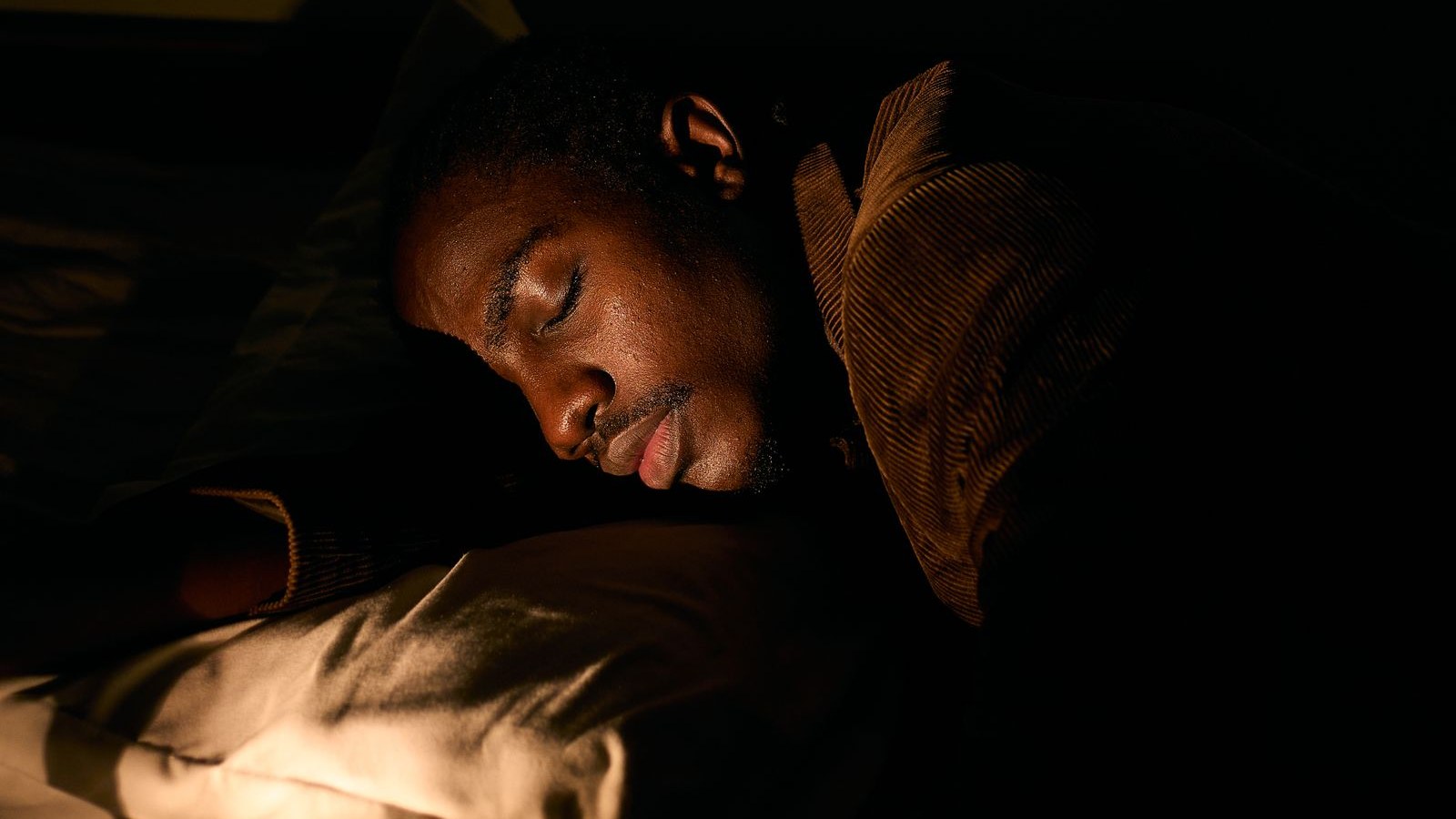
You are ninety seconds from sleep. Your breathing has slowed, your thoughts have gone loose and strange, and then your whole body snaps — a kick, a jolt, sometimes the unmistakable sensation of stepping off a curb into nothing. Your heart is suddenly going, and you are wide awake again, staring at the ceiling and wondering what is wrong with you.
Nothing is wrong with you. This is a hypnic jerk, and somewhere between 60% and 70% of people experience them. It is one of the most common things that happens at the edge of sleep, and also one of the most poorly explained, which is why the internet has filled the gap with falling-monkey theories and electrolyte cures.
Here is what is actually known, what is speculation, and what to do if the jolts are costing you sleep.
TL;DR: A hypnic jerk (also called a sleep start) is a sudden, involuntary muscle contraction that happens as you transition from wakefulness into sleep. It affects roughly 60–70% of people and is usually harmless. The leading explanation is a brief instability in the brainstem's reticular system during the wake-to-sleep switch, which lets a burst of descending nerve activity reach your muscles. Common triggers — sleep deprivation, caffeine, stress, and hard exercise close to bedtime — are based on clinical observation rather than controlled trials. Most people need no treatment. You should see a doctor if the jerks are frequent enough to cause insomnia, if they injure you, or if they come with dream enactment, which points to a different condition entirely.
YouTube: Related video
What a hypnic jerk actually is
A hypnic jerk is a myoclonus — a sudden, brief, involuntary muscle contraction. Myoclonus is a broad category that includes hiccups, the twitch you get when you are startled, and the leg kicks some people have during sleep. A hypnic jerk is the specific version that happens at sleep onset.
What it feels like varies a lot from person to person:
- A single sharp jolt, often in one leg or one arm, sometimes the whole body
- A falling sensation, as if you have missed a step, which is the most commonly reported version
- A flash of light or a brief dream image right at the moment of the jerk
- A racing heart for a few seconds afterwards, from the adrenaline that follows the surprise
They usually last well under a second. The after-effects — the pounding heart, the sudden alertness — last longer, and that is the part that actually costs you sleep.
Most people get them on one side of the body rather than symmetrically, which is a useful detail: it tells you this is a neural event travelling down a specific pathway, not a whole-body reflex.
Why it feels like falling
The falling sensation is the part everyone remembers, and it is the part with the weakest evidence behind the popular explanation.
The most widely repeated story is that your body relaxes so completely as you fall asleep that your brain misreads the muscle relaxation as a fall and fires a corrective jerk. It sounds plausible. It is also, when you go looking for the study that demonstrated it, essentially absent. Reviews of hypnic jerks tend to conclude that the origin is not definitively established.
What is better supported is the general mechanism: a brief instability in the transition between wakefulness and sleep, during which the brainstem's reticular formation — the network that governs arousal and muscle tone — sends a sudden descending burst of activity to the spinal cord. That burst produces the contraction. In other words, the jerk is probably a glitch in the handover of control, not a rescue mission.
The same instability explains why the experience is so often accompanied by a fragment of dream or a flash of light: you are catching the very first moments of sleep mentation as it starts.
How common are they
Very. The most commonly cited figure, from a video-polysomnographic study of hypnic jerks, is a prevalence between 60% and 70% in the general population. A separate review on hypnic jerks and antidepressant use puts the lifetime figure at up to 70% of adults.
They occur at all ages and in both sexes. Many people have them for a stretch of their life and then stop noticing them, which is less about the jerks disappearing and more about the brain filing them as irrelevant.
The people who end up searching for answers are usually in one of two groups: those who have started getting them several times a night, and those who have developed a low-grade dread of falling asleep because of them. The second group matters more than it sounds. A jerk that wakes you is annoying; a jerk you spend the evening anticipating becomes a sleep-onset problem in its own right.
What actually triggers them
This is where you need to separate what is observed from what is proven.
Observed in clinical practice, not proven in trials:
- Sleep deprivation. The most consistently reported trigger. Short sleep and irregular sleep timing both seem to make the wake-to-sleep transition less stable.
- Caffeine and nicotine. Both are stimulants, both narrow the gap between "tired" and "wired", and both are commonly reported by people who get frequent jerks.
- Stress and anxiety. Higher arousal at bedtime means a bigger distance to fall into sleep, and a rougher landing.
- Vigorous exercise close to bedtime. Reported often, though the exercise-and-sleep literature is genuinely mixed and this is unlikely to be a problem for most people.
- Fatigue and physical exhaustion. Counterintuitively, being physically wrecked seems to increase rather than decrease the jerks.
Supported by more than anecdote:
- Antidepressant use, particularly SSRIs. A 2023 review examined the relationship between hypnic jerks, major depressive disorder, and antidepressant treatment. Serotonergic drugs are known to increase myoclonus generally, and sleep starts are part of that picture. This does not mean the medication is a problem — it means the association is real and worth knowing if the jerks started around the same time as a new prescription.
- Other stimulant and serotonergic drugs, including some ADHD medications, which follow the same logic.
If you want a simple experiment rather than a list: pick the two triggers that apply to you and change them for two weeks. The usual candidates are a caffeine cutoff in the early afternoon and a slightly earlier, more consistent bedtime. Those two changes are also the ones with the best general evidence behind them for sleep quality, so you are not wasting effort even if the jerks turn out not to be the main issue.
What hypnic jerks are not
This is the section that matters most, because a lot of people with a real sleep disorder get told they have "just hypnic jerks" and lose years.
Restless legs syndrome (RLS) is an urge to move the legs, usually in the evening or at rest, relieved by movement. It is a sensation, not a contraction, and it happens while you are awake and lying still. If you find yourself stretching, walking, or kicking your legs to settle them before sleep, that is RLS, not sleep starts.
Periodic limb movement disorder (PLMD) is rhythmic, repetitive leg movement during sleep, typically every 20–40 seconds in runs. You usually do not know it is happening; a bed partner does, or a sleep study does. It is not a single jolt at sleep onset.
REM sleep behaviour disorder (RBD) is the one to take seriously. In RBD, the normal paralysis of REM sleep fails, and people act out their dreams — punching, kicking, shouting, leaping out of bed. It tends to affect older adults, often men, and it is associated with later neurological disease. A jerk at sleep onset is not RBD. Kicking or thrashing in the middle of the night while dreaming is.
Sleep paralysis is the opposite problem: you wake up unable to move, sometimes with a sense of a presence in the room. It happens on the way out of sleep rather than the way in.
Exploding head syndrome is exactly what it sounds like — a loud bang or crash at sleep onset that does not exist. It is a separate parasomnia and, despite the name, harmless.
Epilepsy is rarely the answer, but myoclonic seizures exist and can cluster around sleep transitions. Red flags are jerks that are repetitive and clustered, that come with confusion afterwards, or that have been steadily worsening.
Benign fasciculation is a continuous muscle twitching rather than a single jolt, and it is not sleep-specific.
The practical rule: a single jerk as you fall asleep, that you can remember clearly, is a sleep start. Anything rhythmic, anything during the night, anything with dream enactment, or anything that leaves you confused, is a different conversation.
When to see a doctor
Book an appointment if:
- The jerks happen most nights, or several times a night, and are stopping you from getting to sleep
- You have injured yourself, or you are worried you might — falling out of bed, striking a partner
- You act out dreams: shouting, punching, kicking, or getting out of bed while asleep
- The jerks come with confusion, memory gaps, or a loss of awareness
- They started around the same time as a new medication
- You have other neurological symptoms — weakness, numbness, tremor, or changes in walking
- You have severe daytime sleepiness despite adequate time in bed
The last one is worth flagging on its own. If you are sleeping eight hours and still falling asleep at your desk, the jerks are not the interesting finding. That pattern deserves a proper look, including a check for sleep apnea, which is far more common than most people assume and routinely missed.
What actually helps
There is no drug approved for hypnic jerks, and for most people the right answer is behavioural. In rough order of usefulness:
1. Make sleep onset boring and predictable
The jerk is a transition problem, so shortening and smoothing the transition helps. A consistent bedtime, a wind-down that starts 30–45 minutes before lights out, and getting into bed sleepy rather than exhausted. This is the same advice that turns up in every insomnia guideline, and it applies here because the mechanism — arousal at the sleep boundary — is shared.
2. Move your caffeine cutoff earlier
Caffeine has a half-life of roughly five hours, longer in some people. A 4pm coffee still has a meaningful amount in your system at 10pm. If you get frequent jerks, try cutting caffeine at noon for two weeks and see what happens.
3. Don't fight the jerk
This sounds soft, but it is the most useful thing in this article for anyone who has developed a fear of it. If you jolt awake, do not lie there checking whether it will happen again. That vigilance is itself arousing, and arousal at sleep onset is the fuel. Roll over, reset, and let it go. If you are awake for more than about 20 minutes, get up and do something dull in low light until you are sleepy again.
If the pattern has become a full insomnia loop — dreading bedtime, watching the clock, sleeping worse because you are worried about sleeping — that is worth treating properly. CBT-I is the first-line treatment for insomnia and it works on exactly this kind of sleep-onset anxiety.
4. Handle the obvious physical contributors
Hard training late in the evening, a heavy meal right before bed, and alcohol all make sleep onset messier. Alcohol is the sneakiest of the three: it puts you to sleep fast and then fragments the second half of the night, which is why a couple of drinks can produce a night of jolts and wake-ups. If you want the data side of that, the wearable picture is covered in what alcohol actually does to sleep and recovery.
5. Check your medication list
If the jerks started with a new SSRI or stimulant, tell your prescriber. Do not stop anything on your own. Often the answer is that it settles after a few weeks, or that a dose timing change helps.
What your watch can and cannot show you
A wearable cannot detect a hypnic jerk. There is no accelerometer signature it is looking for, and the movement is too brief and too small to reliably separate from normal sleep-onset movement.
What a watch can show you is the aftermath:
- A heart rate spike at sleep onset, usually a brief jump followed by a return to a sleeping rate. If you see the same pattern most nights around the same time, that is a reasonable proxy for repeated jolts.
- A delayed sleep onset — the gap between getting into bed and the first sustained drop into sleep.
- A lower sleep efficiency on nights after a bad run of jerks, because the wake-ups fragment the first sleep cycle.
- A slightly higher resting heart rate the following morning if the night was broken.
None of that is diagnostic. All of it is trend information, which is the only kind that reliably means anything. Century pulls overnight heart rate, HRV, and sleep stages into a single daily score, so a run of rough sleep onsets shows up as a pattern rather than a series of one-off bad nights you forget about by Wednesday.
If you are waking repeatedly and cannot work out why, comparing your sleep fragmentation pattern against your own notes is more useful than any single night's data. Two weeks of logging "jolted awake at 11:40" next to your sleep chart will usually show you something a score cannot.
The short version
Hypnic jerks are a normal glitch in the machinery of falling asleep. They are extremely common, they are brief, and for most people they need nothing more than a slightly steadier bedtime and less caffeine in the afternoon.
The falling sensation is probably not your brain rescuing you from a fall. It is more likely a burst of nerve activity during an unstable handover between wake and sleep, which is why it arrives with a flash of dream and a racing heart.
The things worth acting on are the things that destabilise sleep onset: sleep debt, stimulants, stress, alcohol, and an irregular schedule. And the things worth getting checked are the ones that do not look like a sleep start at all — rhythmic movements, dream enactment, confusion, or injury.
If you want the broader picture of what happens as you drift off, sleep inertia covers the other end of the same transition, and sleep fragmentation covers what happens when the night keeps breaking after you have got there.
Century AI helps you understand your body with a daily health score, recovery score, and sleep insights — using the watch you already wear.